.png)

“Airports are a type of transition space,” Heather Karch told me as we walked around Seattle-Tacoma International Airport (SEA) on a Tuesday afternoon. “But there's no reason those transition spaces should be void of culture or not attentive to our cultural moment.”
Airports are the first and last impression for a visitor, and the first sense of familiarity for locals. That’s why Upgrade SEA, the airport’s ongoing capital project, aims to “elevate your experience from curb to gate” — including in the restrooms.
A labor of love and a feat of impressive teamwork, the Restroom Renovation project began construction in 2020 with Karch, the airport’s Facilities & Infrastructure Architecture Manager, as part of the multi-department effort. Now, thirteen fully renovated restrooms later, they’re wrapping up.
Perhaps you’ve already noticed that navigating the new restrooms in the B, C, and D Concourses is a bit easier — with more hooks, convenient (and aesthetic) cubbies for purses, and enough space to wheel a carry-on into a stall without careful maneuvering. You may have also noticed the increase in wheelchair-accessible stalls, ambulatory stalls (which have parallel grab bars for people who need support sitting and standing), family restrooms, changing tables for babies and adults, and service animal relief areas. Or perhaps you’ve just noticed the impact: your airport experience is a bit more enjoyable.
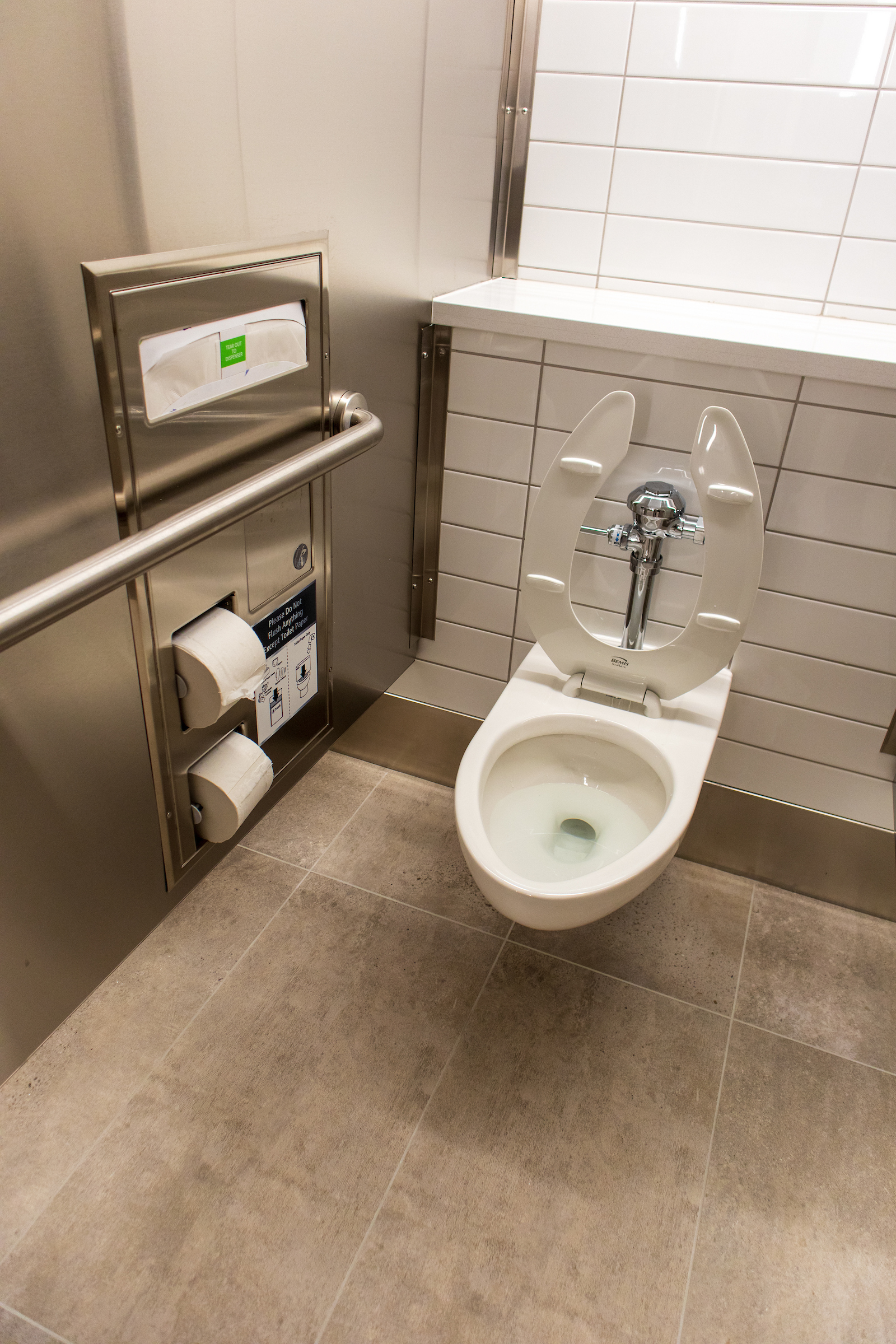
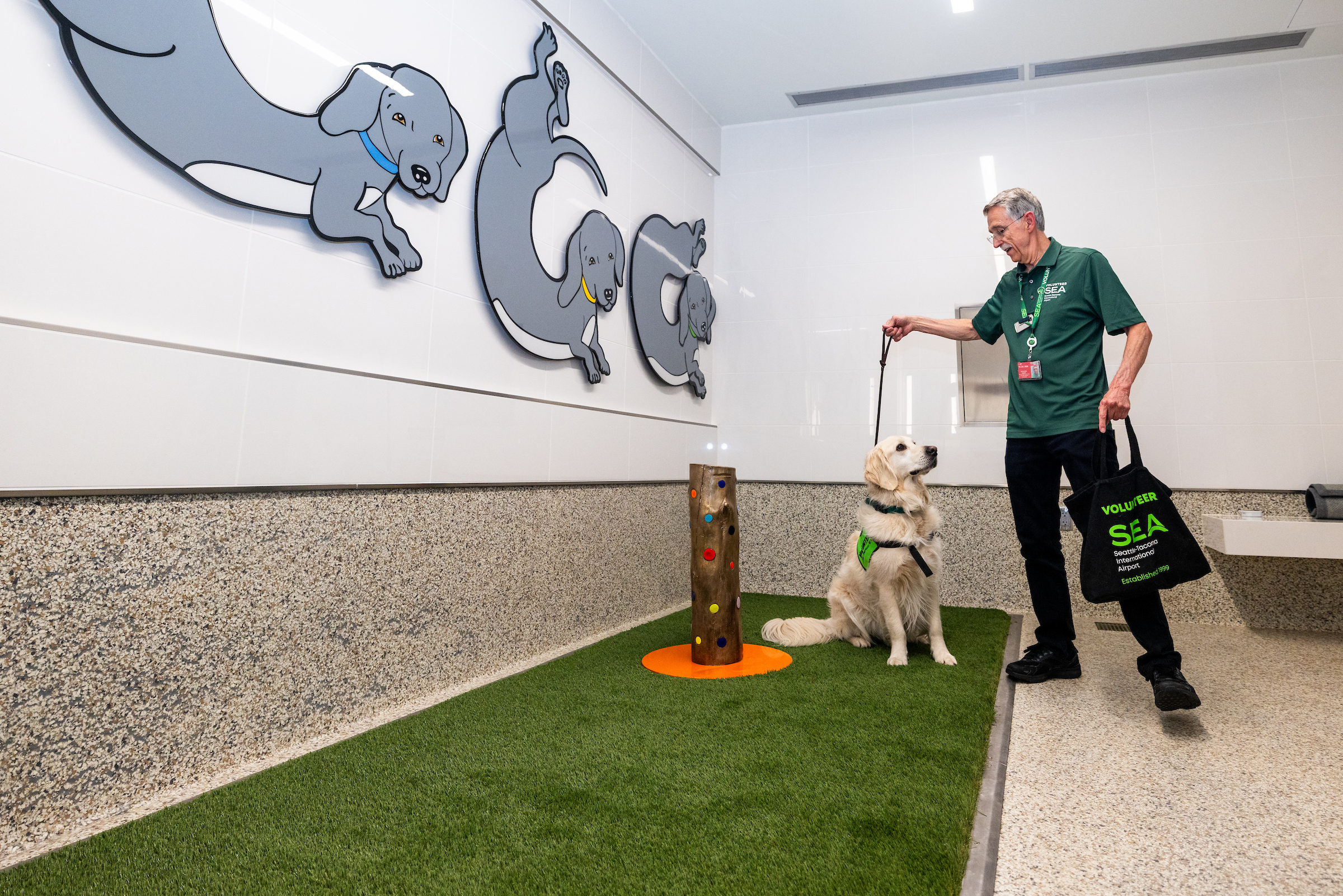
When it comes to the restrooms, “everyone has a general expectation,” Greg Gobat, Senior Architect of Aviation Facilities & Infrastructure, noted. Especially in an airport, that’s not much: sinks and stalls, mirrors and tile, trash cans and soap.
It’s easy to stick to those basics and let aesthetics fall to the bottom of the list. Instead, SEA’s Restroom Renovation team decided it was worth the extra time, effort, and energy to collaborate with other departments to elevate each passenger’s experience, turning the transitory experience into something worth enjoying.
Selecting Your Stall
If you’ve heard about one part of the Restroom Renovation project, it’s likely the new all-gender restroom near gate D2. It’s an early stop in our tour and a crowd favorite for my guides.
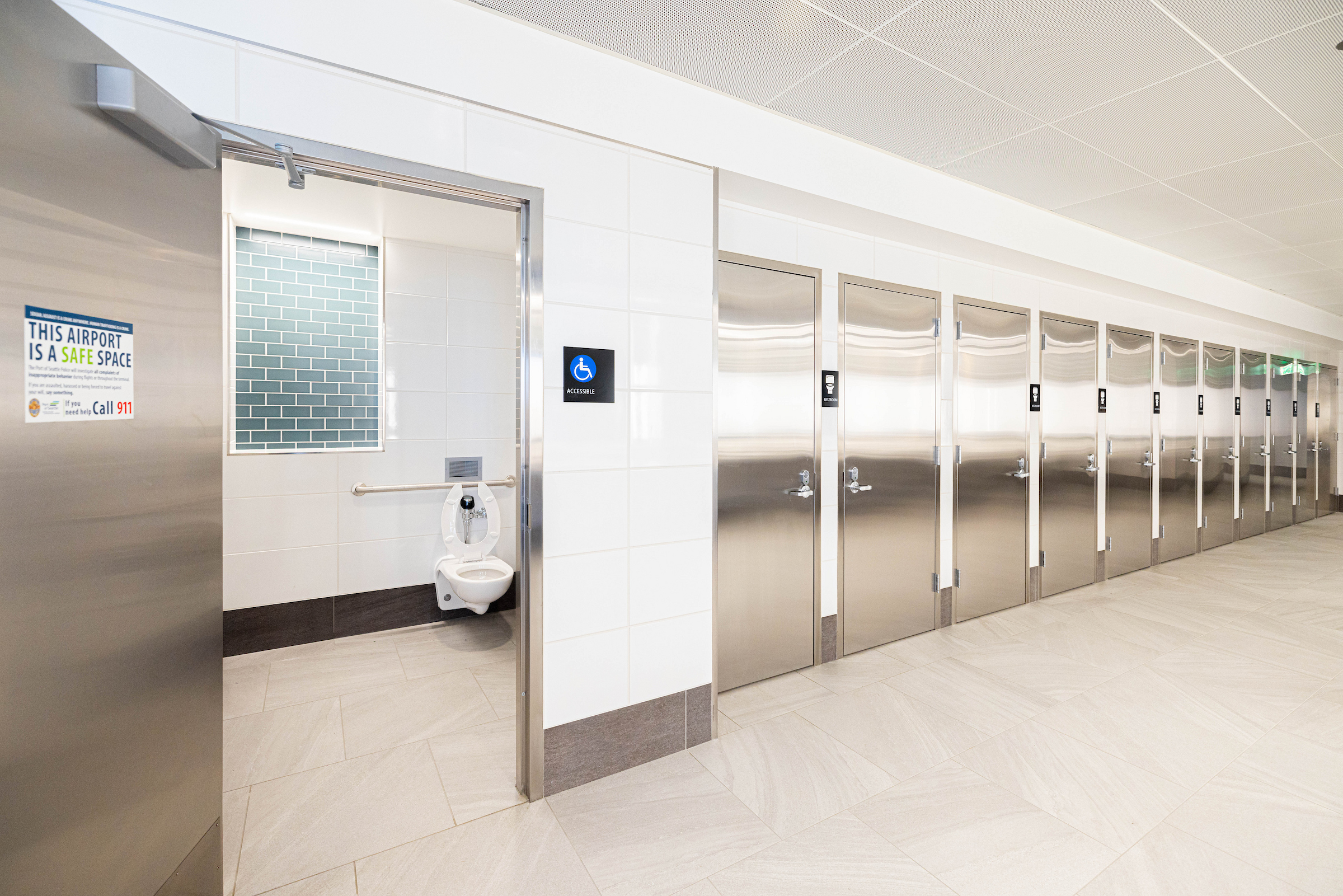
Not only is it the first all-gender restroom at SEA with multiple stalls, it’s one of the first ten or so in the country. The Port of Seattle, which owns and operates the airport, aims to be “a more inclusive space for passengers and give those who might identify differently a place where they feel welcome,” Karch explained. “They don't have to choose [a restroom] based on a previously established societal framework.”
Communicating that choice to international and domestic travelers alike proved an interesting challenge. The team gathered stakeholders, members of the LGBTQ+ community, and faith-based organizations to discuss the best symbols to use on signage, as well as referencing industry research for symbology.
“We determined that our path forward would really speak to what's inside,” said Cindy Maki, Facilities and Infrastructure Manager, Signage and Wayfinding, “Really just leaning into not who uses it specifically, especially if it is for multiple users, but instead what the purpose of that space is.” In many instances, you’ll notice the typical human stick figure icons alongside an icon of a single or multiple toilets or urinals.
Occasionally, users will enter an all-gender restroom, walk back out, double-check the signs to make sure they’re in the right place, and then head right back in — which implies the signage is working: people can accurately determine the right restroom for their needs, even if it’s an unconscious decision.
Still, Maki wonders if there’s room for growth in ensuring easy wayfinding for passengers: “The use of that space” — what’s available in each restroom, rather than the assumed gender of the user — ”has to be a little bit more described” for passengers. It's another instance where the team rejects “good enough,” striving instead for a solution that benefits all.

When a space is designed with a marginalized group’s needs in mind, the positive impacts often extend far beyond, even if they weren’t intended to. In urban planning, this is generally called the “curb cut effect” after the small ramps extending from the edge of a curb to the street. Originally designed for wheelchairs, they also benefit stroller-pushers, wagon-draggers, and luggage-rollers. In the case of the all-gender bathrooms, the positive side effects abound: the ubiquitous line for the women’s bathroom is shortened or even eliminated; caregivers can accompany their kids, loved ones, or patients regardless of gender; and the compartment-style stalls — with gapless doors and nice tall walls — provide more privacy for everyone.
“In an airport, you have so little [privacy],” Gobat remarked. This model provides a respite to “shut out the noise for a minute,” even during a harried travel day. For Gobat, this sense of privacy lends to a priority the Port calls “wow factor,” those elements that surprise you or make you take notice in a good way.
The “Wow Factor”
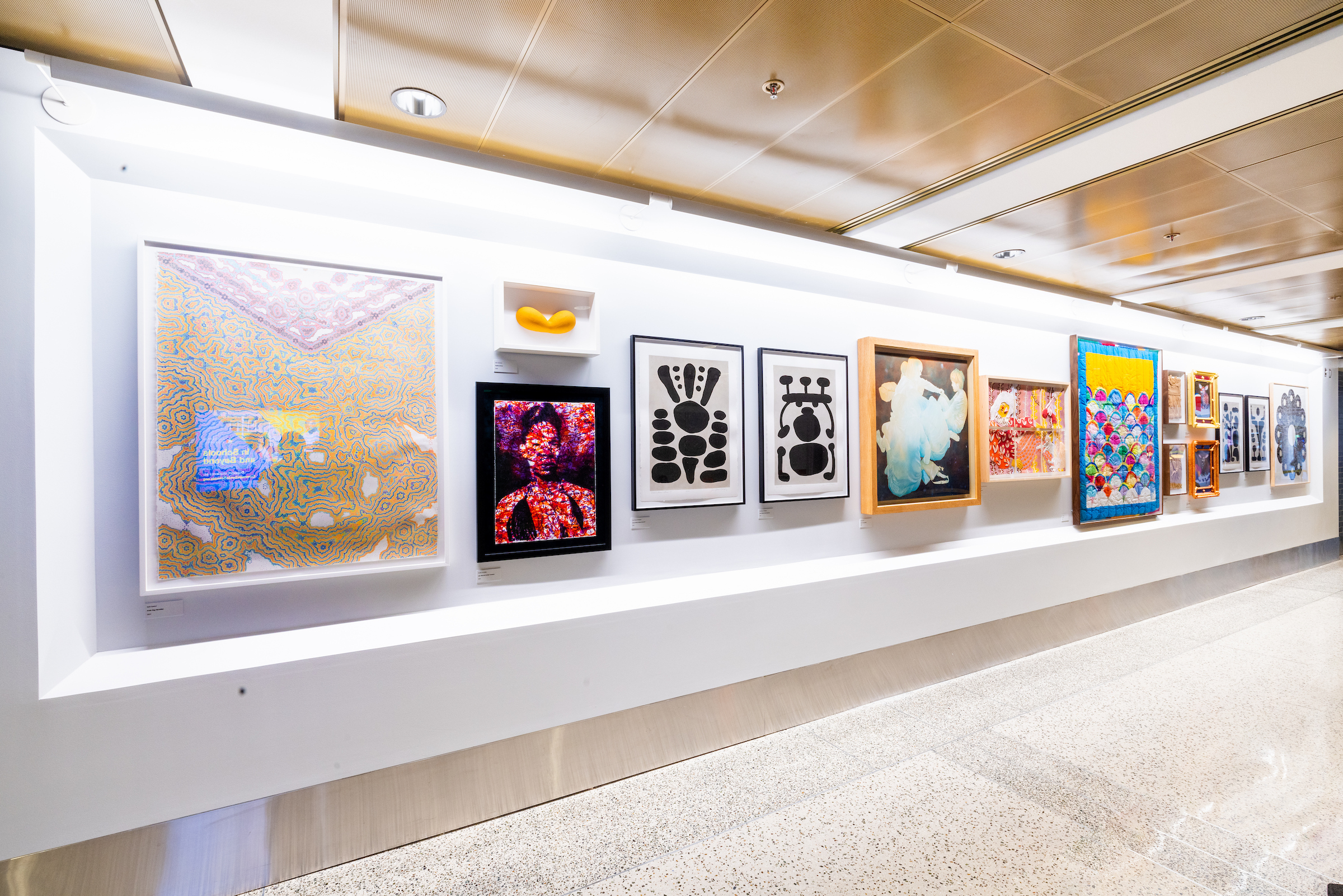
Walking by the D2 restrooms, you’ll catch another element of “wow factor”: the salon-style art wall framed between the restroom’s two entrances, which features 22 artworks meant to “represent, welcome, or support the LGBTQIA+ community.”
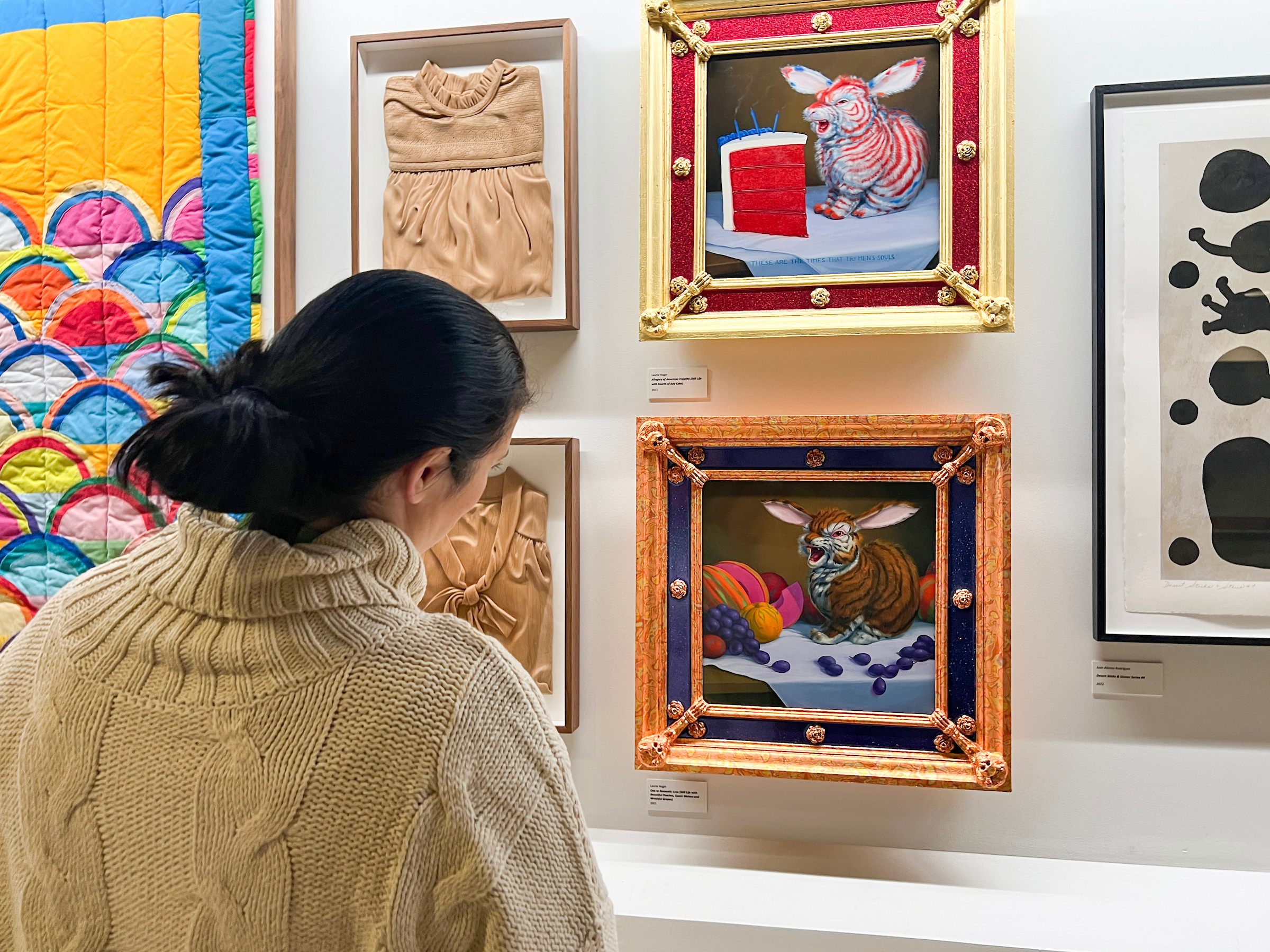
Gobat refers to it as a “five-minute museum moment in your travel, where you can sort of forget about where you need to be for a second.”
There are many of these museum moments throughout SEA, thanks to its robust Public Art Program. Neon art by renowned glass artist Dan Friday greets you at the men’s restroom near A11; two infinity mirror–style pieces by MiNHi England provide a reflective experience for travelers both outside and inside the women’s restroom at B3; and you’ll find video art by Emily Tanner-McLean on your way to the restrooms at C2 — and that’s just to name a few.
According to Tommy Gregory, Public Art Program Sr. Manager and Curator and another one of my tour guides, there’s always been art at SEA. “We’re not doing something completely novel,” he remarked as he and Annabelle Goavec, Public Art Program Coordinator, explained their process for developing the art wall. SEA, the region’s first public agency to establish a public art collection in the late ’60s, now allocates one percent of all capital project budgets to expanding the collection.
Gregory’s approach is pragmatic: “They're not here for the art”; it’s a “supplemental component” to the travel experience. Rather than wishing it would be otherwise, he recognizes the opportunity, likening the art to a “flower bloom,” a moment to “stop and smell” — and indeed, many passengers do, whether enjoying artwork while waiting for the restroom or pausing on the walk to their gate to get lost, just for a moment, in a striking piece.
The original restroom plans, all of which were drawn up in the first of the three phases, didn’t include art. But when the idea for a collaboration struck, both the Restroom Renovation project team and the Public Art Program team embraced it, each bringing their expertise to the table.
Now, it’s an active collaboration with the Wayfinding team as well. In the final phase of the project, they worked with the artists to “[introduce] art at the entry space … so that there is the pairing of the art and the functional signage,” Maki explained, “Trying to find the right balance of design, architecture and signage, lettering.”
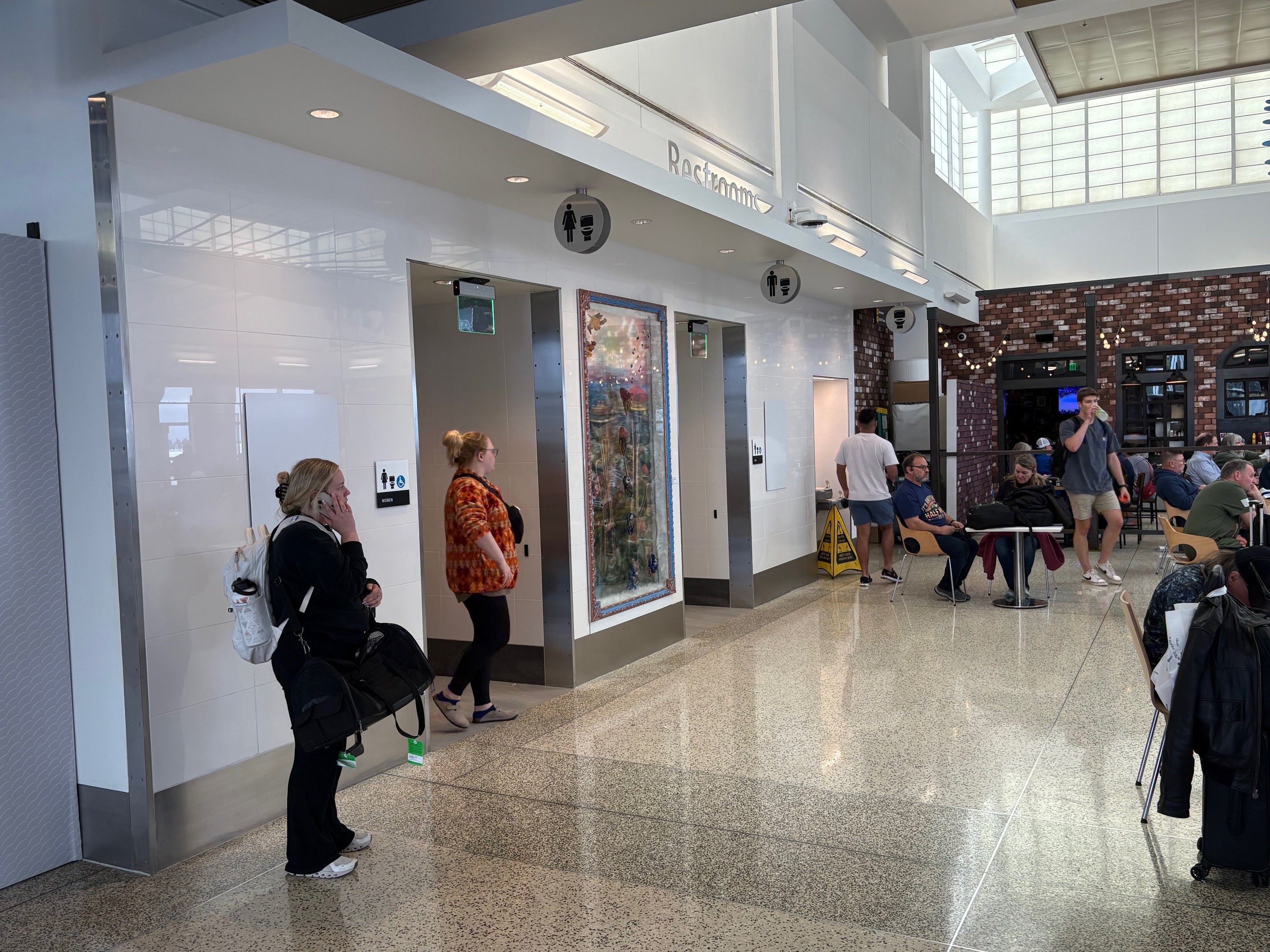
The art incorporated into the restrooms at D11 earlier this year is a great example of this. Created by brother-brother team Einar and Jamex De La Torre, the installation comprises five large framed pieces of lenticular art, which changes based on your viewing angle. In a framed recess between the two gendered entrances, glass sea creatures and hard candies float on a dichroic glass background depicting Seattle icons, including renderings of the Space Needle as a trumpet and cactus.
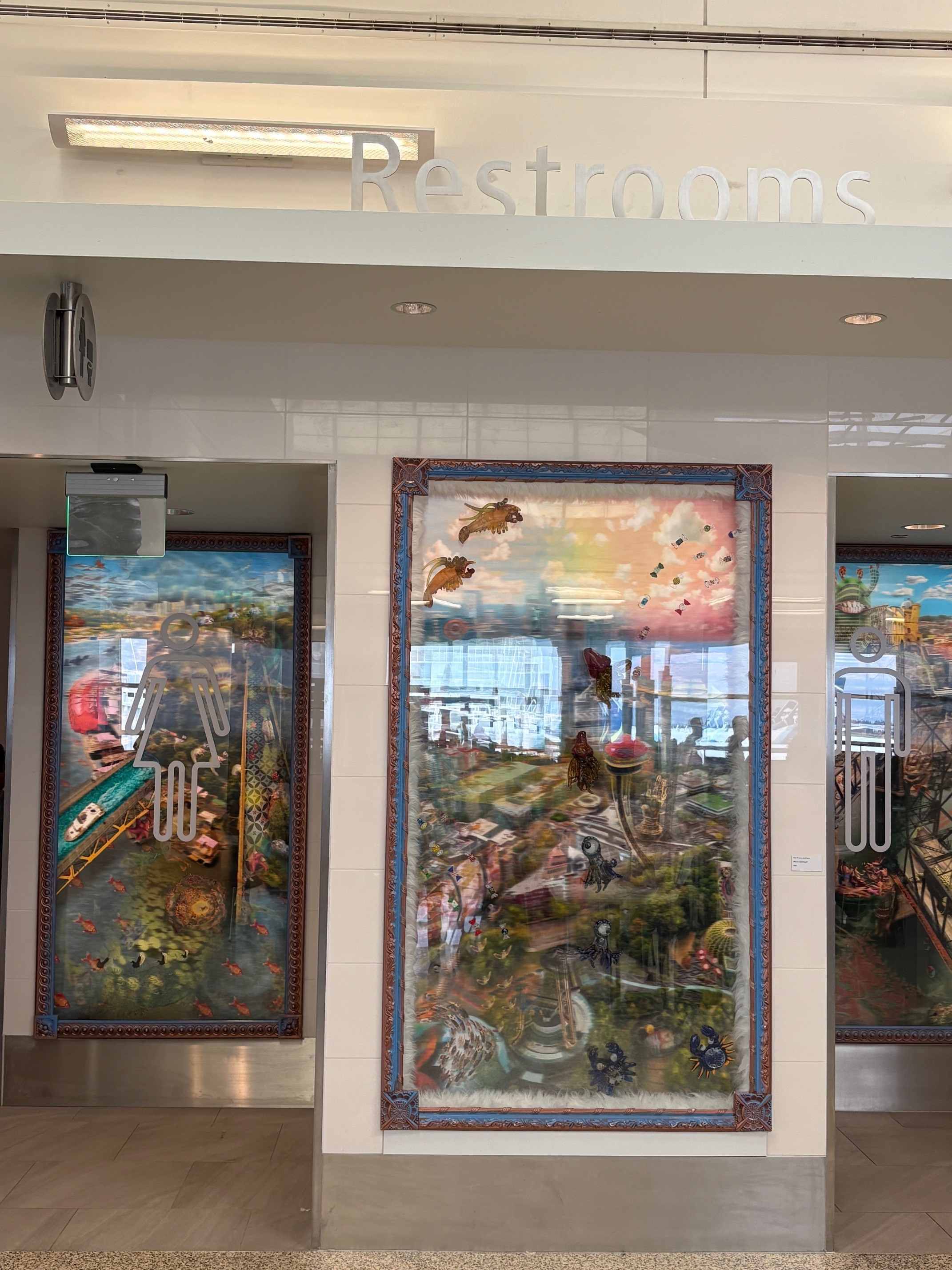
At the entrance to each side are two companion pieces, each overlaid with a large white stick figure to indicate the restroom’s gender. Inside each restroom is one more piece, nestled between the stalls and sinks, bringing art into the bathrooms themselves, too.
It’s a striking and memorable installation deeply rooted in Seattle, not just because of its subject, but also its juxtaposition. “The inclusion of art at all in restrooms is certainly something that is very on brand for Seattle,” Gobat opined. “The Pacific Northwest in general is a very arts-heavy, culturally-rich area. We have a lot of history to be able to pull from in that sense.”
In that way, it adds to the airport’s sense of place — “an authentic expression of the region and community,” as the Port defines it. Sense of place isn't something most people think about in an airport, but it was a priority for Upgrade SEA, and for good reason. “By designing a place of sense — designing in such a way that travelers can rely on their instincts to navigate the airport with ease,” the design firm Gensler suggests to airports, “we can meet travelers’ fundamental needs while immersing them into a space that celebrates its context.”
Unsurprisingly, this is the first time most of these artists have been featured in bathrooms. Like many others, the De La Torre Brothers were into it: “They’re like, ‘Fun!’ It’s like a captive audience, right?” Gregory shared. “I think they're really happy that they did it.” The brothers’ post-installation Instagram reel confirmed their geographic enthusiasm: “Located at the entrance and even inside the gendered bathrooms!” it exclaimed.
Camaraderie? In This Economy?
As Gregory walked me through the multi-step process of moving from idea to successful installation, which included amendments to the architectural plans, he paused and turned to Gobat and Karch: “Again, thanks to y'all for adding the extra depth to give them that space to do the 3D objects.”
To me, this collaborative spirit is also part of the “wow factor.” It’s not always the smoothest or most straightforward process and requires a high level of flexibility for all involved, but each individual clearly believes the extra effort is worth the payoff. There’s a true sense of camaraderie that’s rare in any group project, let alone in this kind of work: gratitude is voiced for blueprint adjustments long made manifest, ideas are shared for future collaborations, and the spotlight is eagerly passed around.
I catch snippets of this throughout our tour as my guides are reminded of things they need to connect on — discussions of projects in the works or a quick moment to plan who should be at an upcoming meeting. At one point, Gregory points to a blank wall and asks Karch, “Could I have that?” Her response seems to be an easy yes, the energy of someone who's enjoyed a past collaboration and looks forward to working together again; Goavec jots down some notes to follow up later.
Gobat summarizes the team’s energy with a question that guides their work: How can we develop that space together?
Maintaining a 24/7 Facility
The airport is a 24/7 facility where — let's admit it — people are rarely at their best. Thankfully, the collaborative spirit extends to SEA’s in-house maintenance team (most airports contract out), which means they’re able to have a say in the implementation of the designs.
As Gobat puts it, “It’s amazing how much abuse goes into our facility.” Because of that, he says, “we need to make sure that it’s not difficult for our maintenance group to maintain.”
This means considering every single detail, from tile selection to changing table location, and knowing that what works in one area may not work elsewhere. The salon-style art wall, for example, is recessed to prevent accidental damage from stray backpack swings. They had the same plan for the restrooms’ mirrors, until they realized that, if recessed, a cracked mirror would have to be broken out entirely to replace it; when designed differently, the maintenance team could simply pop it out to replace it.
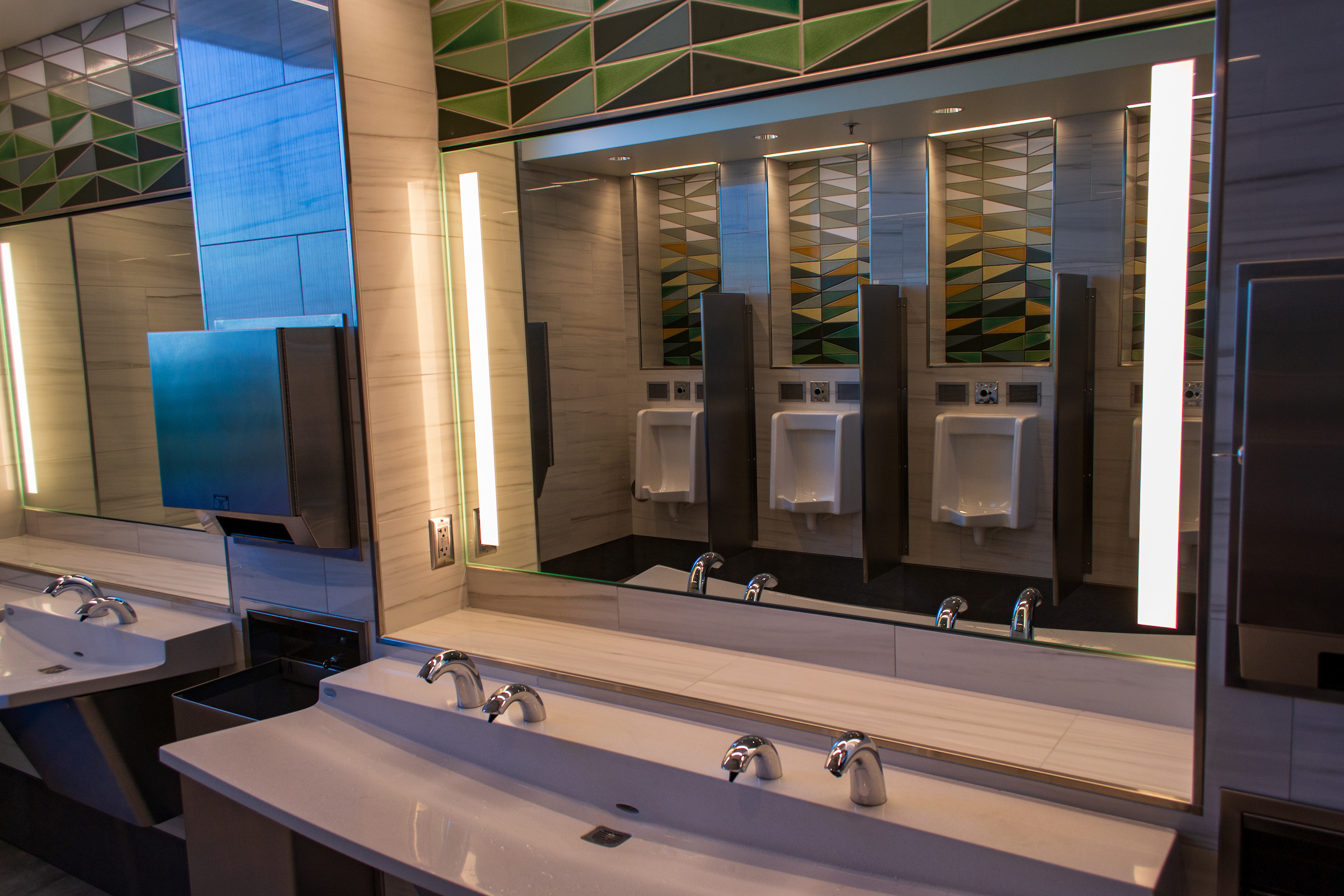
Similarly, the team ran into a surprise with lighting when construction wrapped up on the bathrooms at D5. Several individual restrooms — each with its own sink and toilet — are tucked away in a cul-de-sac off the main drag, a unique layout for SEA. There, the same lighting design that makes other SEA restrooms feel light, bright, and clean isn’t sufficient; the corridor leading to the individual restrooms feels darker and dingier than they expected. The team took this as a lesson learned: in the future, “if the layout changes, how does our lighting change to accommodate that?” Gobat asked. This means yet another collaboration: working with the electrical department’s specifications and standards.
These collaborations aren’t always perfect, of course, and don’t come without their frustrations. Many of the newly renovated restrooms have recessed shelves outside of their entrances, originally intended for a technology integration that has been delayed (perhaps the greatest frustration to the architecture team is that those shelves are often used as makeshift trash cans for those who can’t be bothered to find real ones). Of course, most travelers don’t even notice them.
In many ways, if they’ve done their job well, their work will go unnoticed. After all, people rarely notice when their expectations are met, and exceeding expectations in cleanliness or lighting is only noteworthy when the expectations are so low that “passable” is a surprise. Only through this group’s great care for every single element does the effort become almost invisible to users.
***
As they reflect on their successes throughout the B, C, and D Concourses, the team is already looking ahead to their next project: the S Concourse renovations.
I asked Gobat, now transitioning to a new job at LAX, if he had any hopes for the approach. True to form for this team, he opened with praise and appreciation: “Heather [Karch] in particular has worked hard to … open more doors and empower the staff [under her purview] … to be able to connect better with construction management — or project management or our team or whoever it might be — in order to have more successful projects.”
“The more that SEA does that,” he concluded, “the better their final results will be.”
It reminds me of a sentiment Gregory shared during the tour: “I think the more we experience better things, the better we will be. Give people things that elevate their life experience, and/or [that] make them look at other people's ideas … and not be so isolated,” and not only will their lives be better, but they will be too.
If that’s true, I genuinely believe that everyone who uses the new bathrooms at SEA will be a little bit better. I can only hope that other entities — whether local developers, public agencies, or airports across the globe — will take a page out of this team’s books, embracing how genuine collaborations can help marry functionality with aesthetics, making transitory spaces a little more delightful and, perhaps, making us all a little better.



.jpg)

.jpg)