

The Museum of Flight, located in Tukwila, Washington, is home to over 175 aircraft and spacecraft, and for a limited time, one incredibly unique plane: a Soviet supersonic jet fighter covered in millions of vibrant glass beads. This is one of the first art exhibits at the Museum of Flight, featuring work by LA-based South African artist Ralph Ziman. “The aim of The MiG-21 Project,” the exhibit description reads, “is to take the most mass-produced supersonic fighter aircraft and to turn it from a machine of war into something that looks beautiful, changes the meaning of it.” It further reads that Ziman’s work “addresses the impact of the arms trade on global conflicts and the continued militarization of police forces around the world.”

The work is undeniably unique, massive, and beautiful. Yet, the exhibit raises many questions: Why is an art piece that aims to protest the global arms trade in a museum that traditionally celebrates aircraft in the global arms trade? Is the Museum of Flight using this exhibit to reckon with the weapons displayed within their walls, or to absolve their planes of the crimes they have committed?
Much of Ziman’s work revolves around his experience growing up in Apartheid South Africa. As a white person, he was not subjected to the horrors of Apartheid directly, but he witnessed the daily horrors inflicted upon his Black peers. When it was time for Ralph to serve his mandatory conscription in the South African Defense Force (SADF), he fled the country and lived undocumented in the UK for five years. He eventually returned to a post-Apartheid South Africa and began his career as a filmmaker, artist, and sculptor. Currently based in LA, he has spent his career making art dedicated to non-violence and peace.
For years, Ziman had the idea to make AK-47s out of beads. While working on a film in South Africa, he stumbled across beaders on a street corner in Johannesburg selling their goods. He recalls, “I walked up to them and said, ‘Hey, can you make me an AK-47?’ And they kind of thought it was hilarious.” Twelve years later, he works with the same beaders he met that day, paying them a salary for their work. He has also expanded his team, employing beaders in South Africa and Zimbabwe who make the intricate and stunning beadwork for his large-scale projects.

The aforementioned beaded AK-47s were the first installment of Ziman’s Weapons of Mass Production Trilogy. For part two of the trilogy, he created The Casspir Project, in which he took an Apartheid-era military tank, colloquially called “The Hippo,” and covered the entirety of the weapon in beautiful glass beads. This vehicle is a symbol of the horrors and violence of Apartheid South Africa. Ziman recalls of his childhood frequently seeing “Heavily armed paramilitary police sitting casually on the roofs [of the Casspir] brandishing automatic weapons” as a means to terrorize and intimidate Black South Africans. His goal with this project was to reclaim a symbol of oppression into one of life and hope.
The final installment of the Weapons of Mass Production Trilogy series debuted at the Museum of Flight on June 21, 2025. Upon exhibit entry, directly facing the viewer are the words: “The MiG-21 Project,” “Motivated by social responsibility, fueled by history.” Inside this room are powerful photographs of Ziman’s previous projects—beaded AK-47s in glass cases, samples of the beaded work visitors can touch, and lifesize Afrofuturistic beaded military suits. A sizable wall is covered in a map of the world that features information about the global trade of MiG-21s. (Museum of Flight).
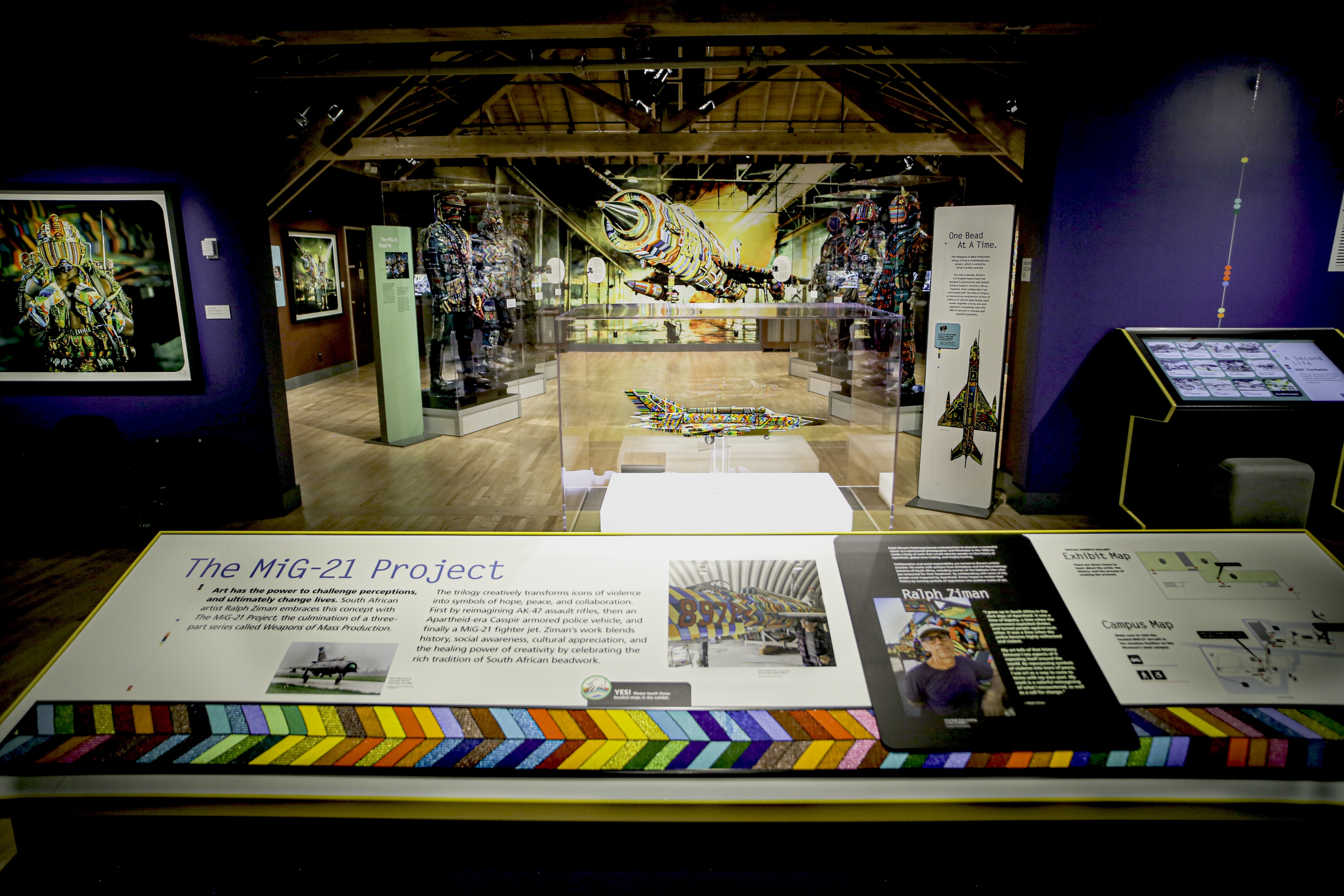
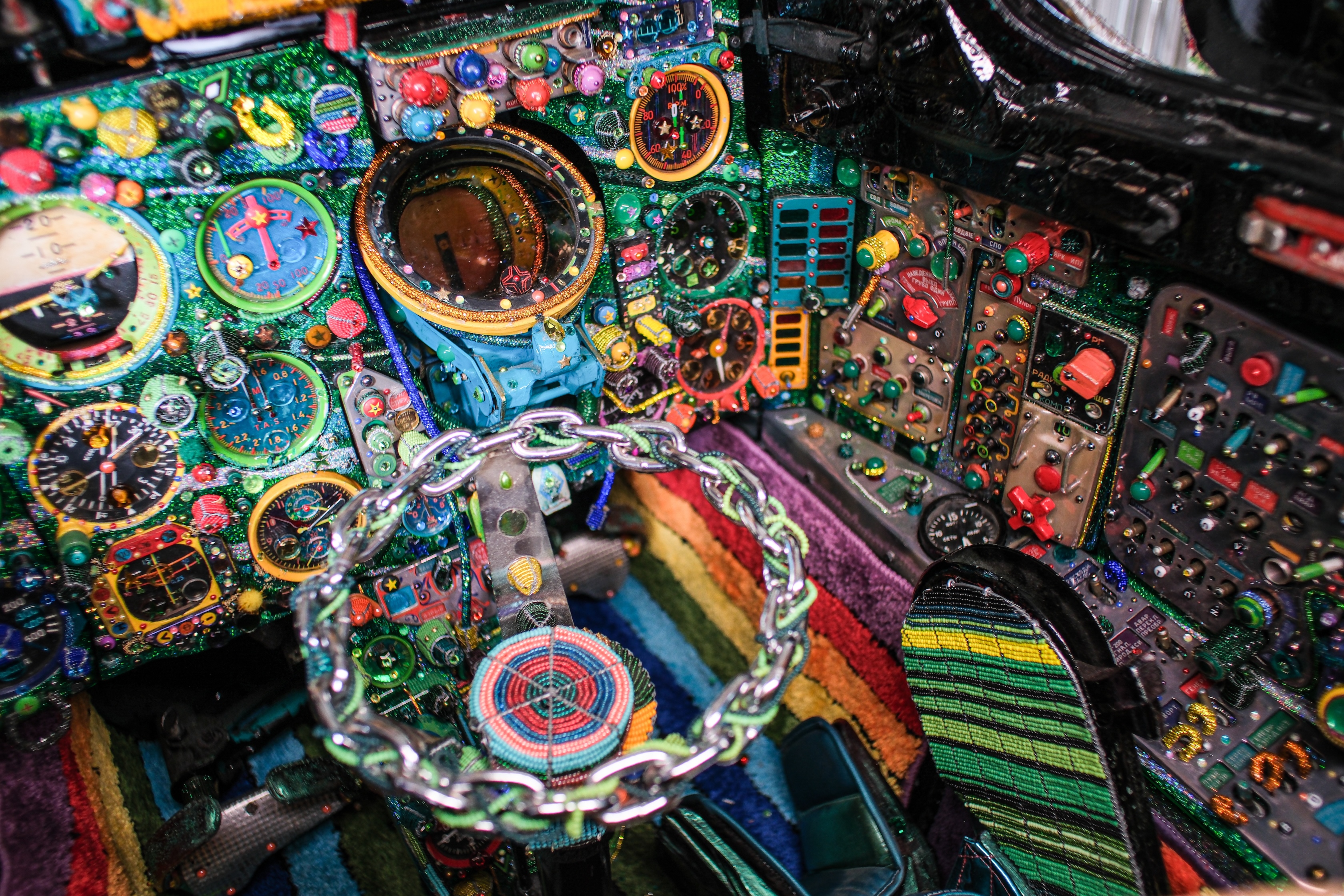
The MiG-21 itself is parked in the Red Barn Special Exhibit Gallery. Exhibit attendees can circle the massive jet and climb up stairs to look into the cockpit, which has been adorned with beads, gems, and colorful patent leather, inspired by East L.A. lowrider car decor. This specific jet, MiG-21 #897, was a Soviet-era weapon previously owned by Poland. The plane was donated to Ziman by Draken International, a tech billionaire-owned company that makes up the largest private tactical air fleet in the world.
An informational sign featuring a photo of the beaded plane reads: “Art has the power to challenge perceptions and ultimately change lives.” The exhibit is striking, specifically in the context of the museum. The Museum of Flight’s exhibits are not usually understood as a protest against the arms trade, but often thought of as a celebration of it. Home to planes from most American wars in the last century, it houses bomber planes from World War I and II, the Vietnam War, and the Korean War. The museum even features a Nazi airplane, Fieseler Fi 103 "V1," built by enslaved laborers in the Holocaust concentration camp Dora. The museum showcases pieces from Boeing and Lockheed Martin, two of the world’s largest arms production companies that have been the target of past and recent anti-war protests. The museum is also a financial beneficiary of arms manufacturers, receiving $30 Million from Boeing in 2015 to expand its STEM educational programs as well as operational support over the years.
One of the museum’s permanent exhibits, Vietnam Divided: War Above Southeast Asia, suggests a celebration of war, violence and American imperialism: “Using displays based upon the design of military airbase protective barriers, the exhibit lends a new perspective to the Gallery's Vietnam War aircraft and highlights the tactics and technology behind their use in combat.” No new exhibits have been announced by the Museum of Flight as Ziman’s comes to a close January 26th 2026. Future exhibits would be an opportunity to incorporate some of the themes present in Ziman’s work which the museum seems to be interested in promoting further: a critique of the global arms trade, police militarization, and imperialism.
This final installment of the Weapons of Mass Production Trilogy series came to the museum because Ziman’s team was displaying The Casspir Project at the Seattle Art Fair in July 2024. Senior Curator, Matthew Burchette, connected with Ziman’s team at the art fair, which spawned the collaborative project between Ziman’s team and the Museum of Flight. Museum of Flight Lead Exhibit Developer Cody Othoudt explains the goal of this exhibit:“[to] connect with the Seattle arts community in a way that we haven't done before.” It is also a part of the museum's new strategic plan to have a wider reach into the local community.
When questioned about the relationship between Ziman’s work confronting the global arms trade and the museum’s part in said trade, both Artist Ralph Ziman and the Museum of Flight Lead Exhibit Developer Cody Othoudt were somewhat evasive during our conversation and did not directly address the potential conflict between the temporary exhibition and the permanent installations at the museum. It felt, to me, that both Ziman and Othoudt could have done more to lean into the tension inherent in Ziman’s work as it relates to the museum - instead, this part of our conversation felt hollow. When asked about this, Othoudt replied, “We have a lot of military aircraft in our museum, so we wanted to pick out some of those and see how they had a second life after their military life. We featured military planes that were repurposed as wildfire bombers, featured in movies, or used to track illegal poaching.”
In a time when the debate on the arms trade dominates the news, the Museum of Flight has taken a risk by exhibiting artist and sculptor Ralph Ziman’s MiG-21 Project. Planes not too different from those admired and displayed in the Museum of Flight are currently dropping bombs in Venezuela and Gaza, made by Boeing and Lockheed Martin and funded by the U.S. Government. If the Museum of Flight is interested in expanding its programming to tackle controversial topics like the arms trade, they should begin the necessary task of reckoning with their own relationship to said arms trade through honest historical research and communication about their planes, and, potentially, by going so far as to divest from the arms trade itself. Many museums and cultural institutions have historically been faced with similar tensions, controversy, and implications. We can only hope that the work of dismantling the perception of the Museum of Flight as a celebration of war is a strong aspect of their intentions to include Ziman’s work, future artistic collaborations, and forthcoming strategic initiatives.|
Exhibit Details
Dates: Saturday, June 21, 2025, Closing January 26, 2026
Location: Aviation Pavilion and Red Barn Special Exhibits Gallery





.jpg)

.jpg)