The Seattle Art Book Fair (SABF), a lively celebration of print media in all its forms, cultivates community through pieces of paper bound and unbound together. It offers independent artists, designers, and publishers the opportunity to showcase their creative endeavors.
I recently had the chance to sit down with the two 2026 SABF Page Turner Fellows, who have received a grant, booth space, and mentorship to help them publish their first books. Mel Isidor, 31, and Dustin Mara, 26, both exemplify the wealth of local talent we are graced with here in Seattle. Humble, intuitive, and strikingly curious, the common threads between their pieces highlight their individual creative identities. Isidor is a designer, urban planner, and mixed media artist who utilizes her research-based background to bring depth to her photography. She leads Isidor Studio, a creative design and strategy practice that focuses on “transforming complex systems and information into clear, engaging, and actionable solutions.” For her upcoming book, Madirisha Mia Moja, Isidor spent time in Zanzibar, Tanzania, documenting cultural memory and the “aesthetics of utility” through an archive of windows. Mara is a freelance visual designer with a specialization in typography. He is releasing the first installment of his print media passion project, BASH, playfully described as “not a book, nor a zine, a gathering in print, a party in progress.” A reflection of himself pieced together through the submissions of those around him, BASH reveals itself as a heartfelt and earnest love letter to community; its breadth, resilience, and at times its seemingly nonsensical makeup.
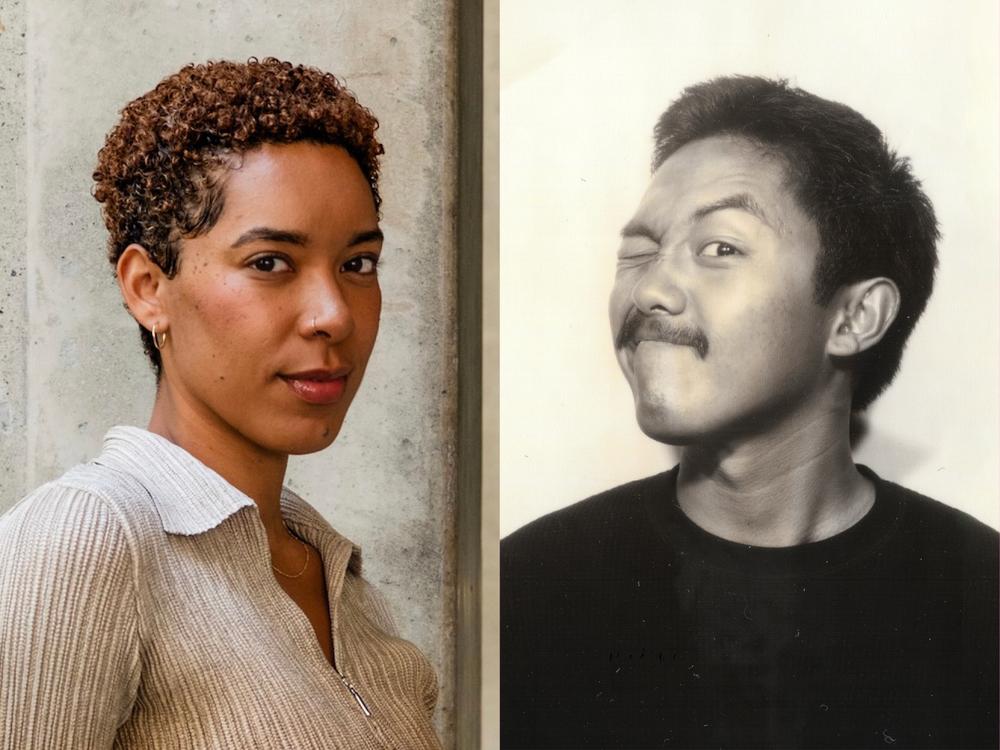
The Seattle Art Book Fair gave these two designers the platform and support to share their work in a space that goes beyond traditional commerce—a place for engagement, representation, connection, and the exchange of ideas.
Dustin Mara: I think the book fair is an interesting space. Having gone and volunteered for the last couple of years, you see everything. There's not a specific genre of book or zine or piece of work that's there. I think it is really cool to see that there are people in Seattle who are interested in everything. Just having the idea of making a book fits that space; no matter what kind of book it is, it will work at the book fair.
Mel Isidor: I think this space allows me to lean into the craft of the book versus maybe in other spaces where I may be a bit more focused on the content in ways that could compromise the creative expression. I could have easily steered this project for the urbanists and architects because there is a niche that would find interest in that, but I think I want this to be much more broadly reaching. I moved from Boston, and I’d say Seattle has been a really great environment to cultivate my creative practice. And even at certain moments where sometimes I felt like Seattle might not be my audience, I've put stuff out there, and then people come back with thoughts and feedback and discussion that make me realize that my work actually resonates beyond who I thought it was for. I've been to the Seattle Art Book Fair before, and I’m excited for how active it is and knowing that people are curious, even if they aren't buying the book specifically, their ability to interact and engage with it is what I’m really looking forward to.
Photography has always been an integral creative thread for Isidor, from point-and-shoot cameras as a kid to an iPhone camera roll today that’s sure to put us all to shame. She has a keen eye for spotting textures and patterns in places many wouldn't think to look. “My phone has, I don't know, just random photos of pavement patterns and sky textures, and I feel like the core of it is documentation. So I'm always curious about documenting things with this concept of ‘Maybe this will be useful one day.’” Her background and education in urbanism and city planning are foundational for the way she sees the world around her, and the spontaneity of her photography imbues a very authentic sense of grit into her images. Cities and space are her core curiosities, tethered to the question: “If you remove people from an environment, what will the buildings say about them?” Maybe most importantly, though, she wants her work to evoke emotion, to be a catalyst for deeper and more sincere discourse surrounding culture, identity, and the world we build around us.
Her new book, Madirisha Mia Moja (translating to One Hundred Windows in Swahili), is a bold archive of images documented during the six months she spent in Zanzibar in early 2023. Containing risograph prints of one hundred windows primarily taken in Stone Town, Zanzibar City, the book is ring-bound and encased in a wood and metal cover. With it, Isidor delivers a fascinating look into the beauty and intricacy that can exist within utility.
Isidor: The idea is that there's not really much text. It's not something that you're going through and reading. The craft will hold its own weight to the point where I'm like, I don't need to overdo it. So I think there was an element of just letting it sit for itself. It's more about this being an art object that you engage with, and you can open up to whatever page. I used metal for the cover to mimic the actual material of the window itself in the fabrication, and by binding the book with rings, you could technically open it up and switch around the order. You could also even take a piece out and hang it on your wall or put it on your fridge. So the book can be deconstructed pretty easily, which is an interesting form that doesn't make it as rigid; it doesn't need to be bound. And with doing so much work on the cover itself, that's the grand gesture. Everything else should speak back to that, so the narrative is cohesive.
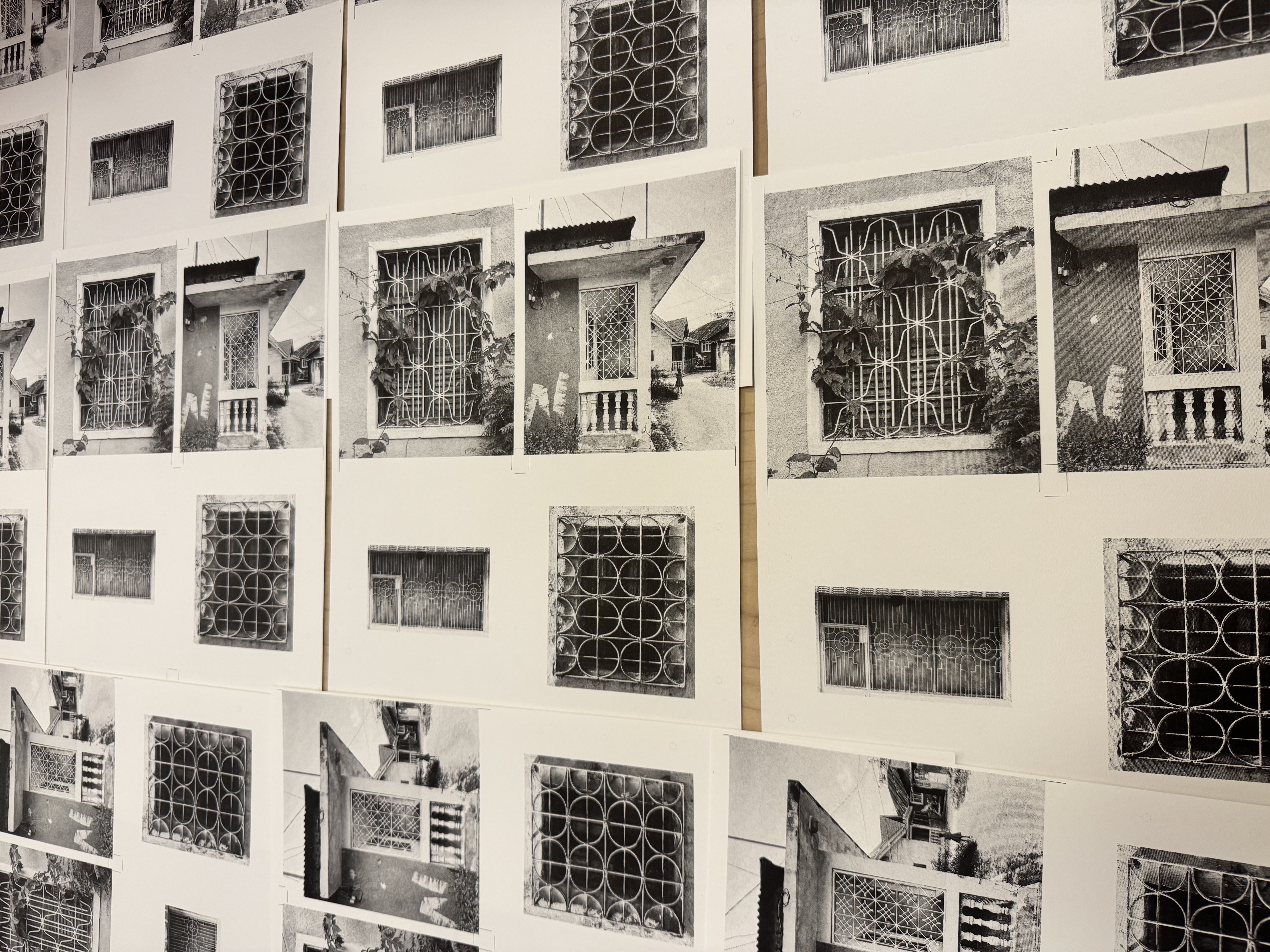
The experience of viewing this book reflects Isidor’s process of making it. Stone Town is dense, lively, and maze-like. In her time there, she explored and wandered, snapping shots of anything that sparked inspiration. The windows continued to speak to her, “I found myself particularly drawn to that place. And even in my apartment, there was a pattern on my windows, and the way the sun would hit, at a certain hour, and just create this moving pattern across the floor was so beautiful.” Flipping through the pages, maybe even taking them out of their loose binding, recreates Isidor's exploration of the city—her discovery of new patterns and more windows.
But why windows? A feature that acts as a threshold between the indoor and outdoor, providing a sense of security and acting as a safety measure. They also allow more air flow and better circulation, functioning as a natural cooling element. Isidor, who is of Haitian heritage, found familiarity in this feature. “In the Caribbean, there's a lot of the same type or similar window grills and breeze blocks with a lot of patterns. There's a lot of cultural influence that goes into the form.” The windows’ unique patterns reveal how history shaped culture in Zanzibar. Colonization of the area, from the Sultanate of Oman to the British Empire, imprinted cultural and religious influences into the architecture. The specific geometric patterns stem from Muslim influence, and they set the design apart from places like the Caribbean or the U.S., where there is a Catholic or Christian majority. “The patterns you would see there would never exist in a place like Haiti; there's a cultural narrative woven in even subconsciously, which I found quite fascinating.” Windows are not the only feature to retain cultural influence this way. Isidor also spoke about ornate doors, a celebrated architectural element in Zanzibar. When I asked again, Why windows then? Why not document these doors? She had this to say:
Isidor: When I was documenting the windows, I noticed they existed across every single architectural form. So even in the simplest structures versus in wealthier homes, it was an architectural element that crossed over class lines in ways the ornate doors didn't. I could wander through the most random alleyway, and I would still find all of these patterns. There was an intentionality behind documenting this element, which seems to be a core architectural piece across class lines. It was very interesting to see the level at which the architectural form varied. And that's what I found so interesting—I would go on walks and would see how unique the patterns were. This idea of craft that's put into these forms that are actually necessary for architecture contrasts with the U.S., where we see so much mass production and so little uniqueness.
Madirisha Mia Moja encapsulates who Isidor is as a creative on a multitude of planes. It gives the viewer an insight into her curiosities, creative process, and motivations. Relying on her skill as a photographer and playing into her love of the patterns and textures found in the urban fabric, the subject matter evokes a sense of familiarity to those who recognize it (much of the Global South). The opportunity to release this book at the Seattle Art Book Fair is vital, as it allows for a more tangible experience. The book itself becomes a space to facilitate discourse and spark thought-provoking engagement.

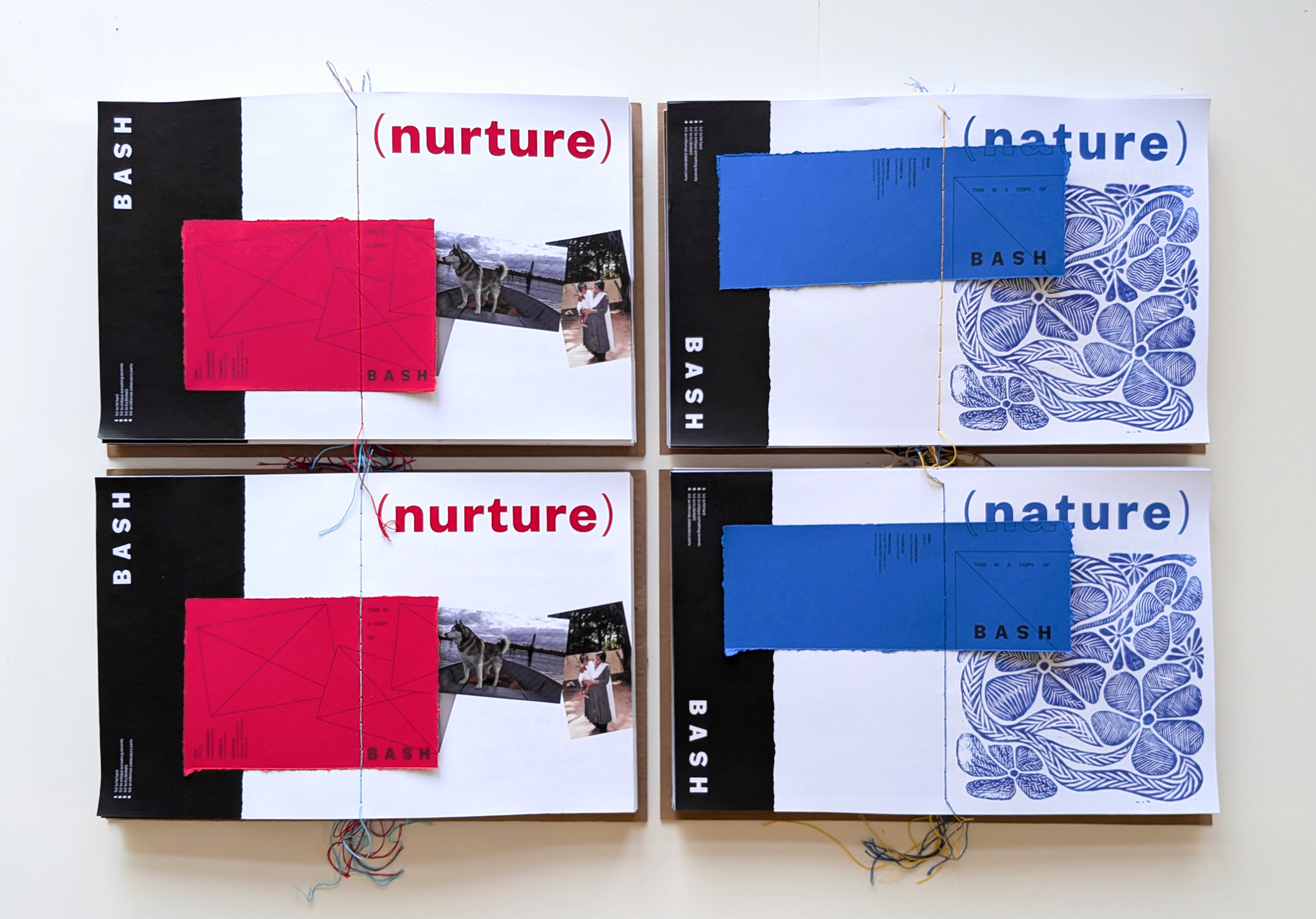
Contrasting the singular subject matter in Madirisha Mia Moja, Mara’s book, BASH, is a busy and vibrant gathering of short stories, poems, long-form essays, and photography. BASH is an exercise in experimentation for Mara, who typically leans into clean, modern aesthetics. The submissions, from friends and family to co-workers and old classmates, display a deep sense of trust Mara has cultivated in his relationships—the trust to be vulnerable, to give, and to share. In return, Mara is vulnerable in his design of BASH, pushing himself out of his comfort zone. “I think the project itself is a reflection of my community, and wanting to use design as a way to think about community building and sharing creativity as an everyday practice. Especially for people who aren't creative.” The reader can feel the care he put into this piece, from the curation and spread design to the hand-done binding itself.
Mara: I wanted to do a book in some form, and I knew I wanted to do several iterations of it. I didn’t know whether I would do it next year immediately, or five years from now, ten years from now, but it was a sign that these are the people in my life, and the culmination of everyone in my life is a reflection of who I am in that current time. I had asked a friend if she would be willing to submit, and she had mentioned how it would also give her a platform to just create. A lot of people in my life aren't designers or artists, so they're not doing creative things day-to-day. They're just going home, watching TV, making dinner, going to bed, and starting their day again. Giving people a platform to be creative and see how being creative has changed my life was part of it. All of these people have spent hours or multiple months working on their piece to go in here. And I'm very, very grateful for that.
Mara did not set any guidelines or ask for any particular topics or themes. Yet he received so many that he was able to split BASH into two volumes, titled ‘Nature’ and ‘Nurture’—a fitting thematic categorization for a piece of media highlighting the mechanisms of community. “I think it's not directly a reflection of my community, but a reflection of the human condition itself. When asked to do something creative, to reflect on their lives, they went to two very distinct places of nature and nurture.” From an ode to motherhood to a documented attempt to grow moss, there is so much diversity within BASH. Differing interests, backgrounds, demographics, cultures, and personalities. It’s the ultimate display of the strength that is found within a community.
Mara: I think that my background, the people I've been able to engage with, and those I have asked to be in this book come from so many different places. So I take these ideas from different people in different parts of the world and put them right up against each other, saying that, at the end of the day, we are all human. And we are all a lot more similar than we think. I want to shed light on that, so even if most of these people will never meet—
Isidor: They’re not as far away as they think they are.
Mara: Yeah. Exactly.
BASH is a party on a page; designed, printed, and compiled with the love and care of someone who knows the worth of one’s community and the joy of engaging in it. The emotional threads of this work are its driving force. Mara chooses to hold up a mirror to all of those who have helped him get to where he is today. In doing so, he also invites the viewer to examine their place in their own community and to hold it dear.

The Seattle Art Book Fair Page Turner Fellowship has given these two creatives the final push to the finish line. They give their thanks to the organization, other supporters, and each other for making BASH and Madirisha Mia Moja a reality.
Mel and Dustin will present their works at the Seattle Art Book Fair, May 9th and 10th. Stop by their booth to snag a copy of BASH and Madirisha Mia Moja, check out their other offerings, and have a chat. If you miss them there, you can find more information about Mel Isidor and her work on Instagram @isidor.studio, or at https://melisidor.com/. You can find more information about Dustin Mara and his work at https://madebybash.com/ and https://mattaiomara.com/.



.jpg)

.jpg)