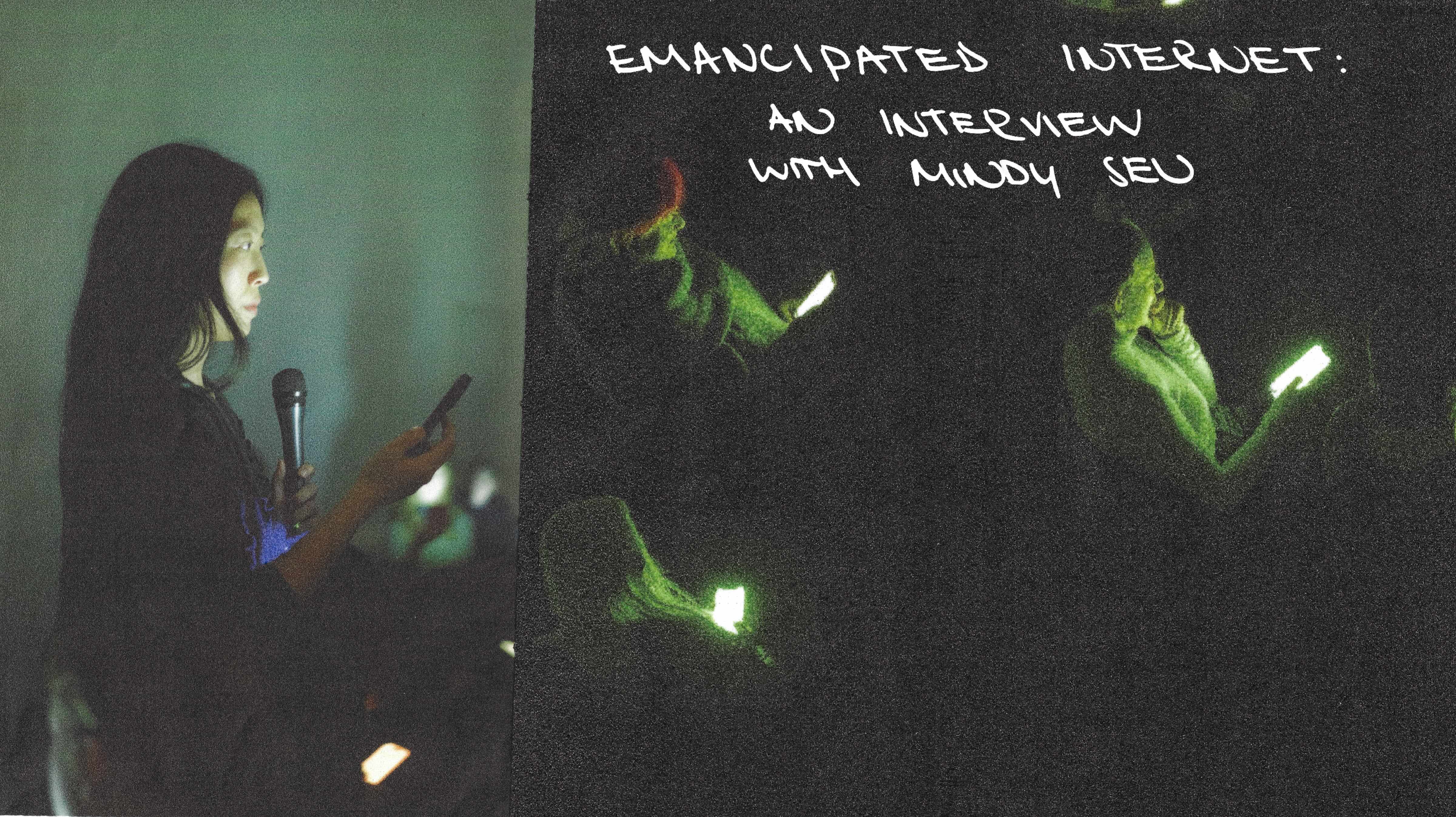

Released by Inventory Press in 2023 as the printed counterpart to its digital database, Mindy Seu’s Cyberfeminism Index quite literally went viral.
Internet-green and designed by Laura Coombs, the Cyberfeminism Index’s brick-like demeanor (extruding over 600 pages) has etched itself into popular culture not just for its aesthetic appeal, but for its nuanced reimagination of “cyberfeminism.” Seu adapts the term and reconfigures it — envisioning a future wherein the landscape of cyberfeminism is vast and varied.
Albeit memorialized in print, the Cyberfeminism Index is a living archive: a global index that arranges hundreds of examples of the multi-dimensional web which artist groups like VNS Matrix have coined as “cyberfeminist.” Seu compiles references that range from digital art to essays and texts on cyberfeminism to curate an expanded history.
Seu’s references go beyond a stagnant understanding of “feminism” and its relationship to technology to include queer, trans, and non-binary voices, ones that decentralize the West, and ones that emphasize a collective and collaborative history of feminist digital culture. And while all these links exist online — it wasn’t until Seu’s index that they were able to do so in direct conversation with each other, networked into a single catalog.
Seu’s latest project A Sexual History of the Internet is an iPhone-sized artist book the same width as the Cyberfeminism Index. Seu brings back the physical index — this time in the form of a script — to accompany the live lecture performances she is conducting worldwide. Seu’s new book expands on previous themes of embodied technologies, questioning how technology is experienced through the body, and its inherent relationship to sexuality, the material world, and the labor market.
Newly released by Metalabel and coming live to Seattle on May 1st, Mindy Seu joins me to discuss her latest project A Sexual History of the Internet and its relation to her landmark Cyberfeminism Index.
***
Camilla Szabo: I’m drawn to the juxtaposition of memorializing the internet via print—extracting a corner of cyberspace and fixing it to a page. On the internet, links break, sites go down, it’s all being generated yet somehow teetering on the edge of disappearance at any moment. In your 600+ page index, I was struck by the decisive use of URLs and @s to create an archive seemingly permanent or fixed out of something as intangible as the internet. Why did you feel like print was an important format in which to compile your index?
Mindy Seu: The Cyberfeminism Index is a project in a few parts. It was first a spreadsheet, then an online database which will run in perpetuity, and then the printed publication. And then also a performative reading with an augmented reality attachment. So print is definitely a big component of the project, but I would say it's one translation of this huge overview of a lot of different media types and artworks and activism movements, et cetera. We try to do our best to point to various permalinks. Obviously, there are several live links in there. But there are links to JStor, links to the wayback machine, links to things that are a bit more robust and durable, internal PDFs and things like this. But it is true, there is a bit of tension with trying to create a printed document of a living subject.
CS: The experience of flipping through the Cyberfeminism Index replicates the sensation of mining the internet — a nonlinear hopscotch, following a thread from one rabbit hole to the next. Can you talk about Laura Coomb's design for the book and how she developed it? Did you work collaboratively, or did you present her with all of the material and she took it from there?
MS: Laura and I have collaborated for a long time. When I was working on this project, we were essentially starting off of the website that had been commissioned by Rhizome at the New Museum, and then built in collaboration with Angeline Meitzler and Janine Rosen, with some support from Charles Broskoski. At some point we froze the website to make a clone of it, so that while the website was growing in perpetuity it wouldn't impact what we were editing for the manuscript. And then my editor, Andrew Scheinman, and I edited it for months in Google Docs and streamlined everything — copy edited, color coded. Laura and I then worked with Lily Healy who was a programmer at the New Yorker, who was basically able to export a Google Doc as a spreadsheet that was imported into InDesign. So we basically scripted the design. Laura would design the publication — the InDesign template with grids, guides, and fonts, so when Lily pulled in the XML file it basically scripted it over the course of 4 to 500 pages. We had about 12 scripts in total, and we would just collate the different templates, so you can see different page types throughout the book. The process was definitely very collaborative, and we were very much inspired by spreadsheets, defaults, internet green, and encyclopedias. Those were some of our key terms.
CS: The book has become such a cultural symbol for our generation. Did you anticipate the mass cultural appeal of the book or did it take you by surprise?
MS: It was definitely surprising because we thought it would be a bit niche. I mean, obviously everyone at this point is an internet user. But I didn't realize that it would kind of become like a marker for a subculture.
CS: Totally.
MS: And then suddenly the objectness of the book, it being bright green, it being really thick, it kind of felt like something I started spotting everywhere. So it was certainly a surprise, but it also made sense. We're living in a time where suddenly the emancipatory potential for the internet has kind of gone away, and I think seeing a lot of examples of people reimagining how it could be used feels like a nice marker for the future.
CS: Did you set out with a specific audience in mind?
MS: While I was making the bibliography I had a lot of friends who were making artwork about an ethical internet, and at that point I was in grad school and doing a fellowship with the Berkman Klein Center. And they were lawyers and policymakers also focusing on ethical internet. It felt like there were people thinking about the same goal but coming from different fields. And I was trying to show the throughlines between those. So, the audience would be internet users and people trying to understand how we can make the internet feel emancipatory again. But it certainly wasn't intended to be relegated towards a certain person, or region, or time period.
CS: Can you tell me a little bit about A Sexual History of the Internet? What were your goals and how do they differ from a Cyberfeminism Index?
MS: Cyberfeminism Index and A Sexual History of the Internet both have the same spine thickness, but Cyberfeminism Index is a project of accumulation, and A Sexual History of the Internet is one of narration. So, many of the examples in A Sexual History you will find in Cyberfem Index. I think when making the first project I realized there were a lot of different thematic throughlines. There were open source movements and things that dealt more with hacking, things that dealt more with wetware. But one of the ones that I felt very compelled by, and maybe a bit unresolved about, was that of embodied technologies. So I decided to make this a more clear essay or narrative arc, which you will then find as the script for A Sexual History of the Internet.
So that project started off as a script for a lecture performance, which we'll be doing in Seattle. And that is a polyvocal participatory performance using Instagram stories. Because when we were testing it so many of our beta-accounts for the performance script kept getting deleted, we decided to print a facsimile as a preservational impulse. So they're both very similar, but they kind of act as their own separate artworks, even if the content is the same.
CS: So originally the performance was meant to be read from an iPhone, and then the book was kind of a byproduct of that.
MS: This is why the book is the size of an iPhone, but extruded to 600 pages.
CS: So interesting.
MS: And the performance, because we're using the native interface of Instagram, is on a timer. We're used to doom scrolling online, but if you touch Instagram and then let it run, it will just autoplay forever. So we basically try to manipulate that behavior by making a narrative through Instagram stories over the course of several chapters, and that led to this 45 minute narrative performance.
CS: That is such a cool process. Can you talk about the theme of citations across your work, and how the audience becomes integrated as a collaborator through the act of “recitations”?
MS: Yes, so the performance is like all writings — it incorporates a lot of different types of citations and references. We try to flatten them by instead of only focusing on academic citations, also incorporating artworks, images, social citations, community citations, things that were told to me verbally… just to show that history is written in a lot of different ways, so we can't wholly rely on a textual record. These quotes are then assigned to different people in the audience. Every one of the audience receives one of five colors, which coordinates to different quotations, and then everyone reads. And it basically becomes this very ritualistic recitation, like a group chant. It feels very religious. Paula Antonelli described it as a Catholic mass because you're in a dark room staring at your phone, and then you're reading your phone with hundreds of others also reading from their phone.
CS: Totally, and it feels rare for people to feel this degree of intimacy or connection when the phone is the object or core of the action.
MS: It’s kind of a magical way to read something together. The book is also a financial experiment in which profit is redistributed to those cited within the book. So this was a nice way for us to think about how an artist project could become a model for redistribution and alternative citation.
CS: I loved your reference to Ursula K. Le Guin in your forward to the Cyberfem Index, using the concept of “gathering” to indicate collaborative sources rather than the singular source that “author” usually implies.
MS: Yeah, and I really do think it’s a strategy that most people use. It's just that in the end, it's allocated to a singular figure. So this was really trying to think about what it means for co-authoring, what that actually looks like, and how authoring can be a form of weaving other people's voices and trying to give as much credit to those voices as possible.
CS: Staging recitations via your audience members feels like a natural extension of this. I wanted to ask you what your relationship is to AI, and how you see it changing the internet? Do you have hopes for the future of the internet?
MS: AI is a tricky one. We saw this huge boom over the past couple of years, it's become extremely ubiquitous and easy to use. Even my mom, who I would have described as a luddite in the past, actively uses AI to write emails and et cetera. It's become embedded in so many of our default tools. I use it for editing help for essays, I use the agentic aspect to vibe code, and it’s been quite useful. But we can also see how it continues to lean on this history of extraction: its extractive use of international data centers and its huge environmental impact. Its extractive data mining from pornographic communities, sexworking communities, and femme people to create these alternate figures like AI chatbots and romance bots. I think the one thing that people don't articulate enough about A Sexual History is that it is about the internet’s history and its relationship to sexuality and embodiment, but even more so it feels like a commentary on the labor market. This is something I wish could be highlighted a bit more. But it's definitely something I think about in its relationship to new technologies.
CS: Is sex something to be protected in the age of AI?
MS: I think we have to define what sex is, which we try to expand upon in the book. If we remove this penetration to procreation pipeline, what exactly is sex? Queer communities have been grappling with this question for a long time. When your intimate lives no longer adhere to a heteronormative structure, you have to completely reinvent what sex, or intimacy, or play, looks like. What relationships look like. So I think we're starting to grapple with this more by queering technologies, and figuring out if intimacy with online interfaces or digital tools counts. But I don't actually think it really matters to try to define it, but rather to really unpack why we do want clear restraints for this thing, and where that kind of social pressure is coming from.
CS: It's crazy to think of AI as having an internal bias — not just being this neutral tool, but one that harbors a bias influenced by its creators and/or funders, and actually often adhering to or perpetuating heteronormative or racist agendas. In your episode of Middlebrow, which I loved by the way, I was interested in the part about trends, subcultures, and taste… I was curious: did the internet kill authenticity? What is the relationship between the internet and “subcultures”?
MS: This is an interesting question. I wish I had been more explicit in the Middlebrow podcast, and shout out to Dan [Rosen] and Brian [Park]. I think we have to define our terms because I hear all the time: “AI art is so bad, AI slop is so bad,” and I wonder how the metrics of good and bad are being defined in arts, because art is extremely subjective. So, we can start by clarifying these metrics. Does good or bad art, if that's the spectrum, align because it feels emotionally resonant, like you see it, and it moves you or not? Is it technically incredible, something that's very photorealistic? Is it historically situated? Maybe it came in a time that was completely reevaluating the time period before it? Maybe it was a huge financial exercise, and it suddenly became the cheapest or most expensive artwork in history. These are all different ways of analyzing what good and bad means. So when I hear that AI slop is bad, it makes me assume you're probably thinking about it in terms of artistic creativity and emotional resonance, right? If there was no human intent behind the thing, it means that the artwork is inherently inhuman and/or bad. Maybe it's because it's not visually very good. Like, we can spot an AI generated image a mile away. So, maybe it's just not technically good enough yet. We have seen some AI pieces start to sell for money. So I'm actually curious — when that sells for a million dollars at Christie's — are we going to then reevaluate what we're saying?
But, like all things, AI is really a tool, and there are some artists who are just throwing things at the wall. And there are some artists who are really examining and creating new methods with the tool. So, a very long winded answer to say, there's no clear answer, and I just wish people would add some nuance to their commentary.
CS: Definitely. Do you think that AI generated art, for instance, has its own spirit? If it's replicating human nature or its idea of it — do you think there's something being imbued into the work that goes beyond its algorithmic or derivative nature?
MS: Yeah, I mean, I think some people start to use it as a partner, or at the very least, an assistant. It depends on what we are describing as spirit or energy, which I think people use to refer to authorship. We started to see these questions emerge when people were doing computer generated artworks, not even using AI. Like, if an artist is creating a set of rules, and then it generates an image, did they author the image, or was that done through the protocol? And I think these are the things that people maybe want clearer answers to, but I think the same goes for AI. There are extremely thoughtful ways people are prompting AI that otherwise wouldn't be created if someone just typed in something very haphazard. So, I think that right now we're exploring how the authoring will impact the quality of the output, and it's this type of authorship that I'm curious to observe.

Don't miss Mindy Seu's lecture performance, A Sexual History of the Internet, coming live to Seattle on May 1, 2026. Presented by Space.City at Cannonball Arts. Purchase Tickets Here.



.jpg)

.jpg)