
“The American Institute of Architects has given an Outstanding Architectural Design Award to a public bathroom in Staten Island,” Colin Jost announced in a February episode of Saturday Night Live’s Weekend Update. “But like I keep telling everyone, it’s not a public bathroom.” As he said this, a photo appeared: the decommissioned Staten Island Ferry that Jost purchased with Pete Davidson for $280,000 in 2022.
The joke here centers around the derelict nature of the non-functioning MV John F. Kennedy (a 2025 New York Times article referred to it as “an immense bathtub toy, racking up docking fees,” which were estimated to exceed $600,000 at the time), playing on the general expectation that truly public restrooms will fall short.
Public restrooms are a public health imperative, and everyone seems to agree that U.S. cities — Seattle included — don’t have enough of them. A 2025 analysis found that Seattle has approximately 28 public restrooms per 100,000 residents. That puts it tenth in the ranking of U.S. cities with the most public restrooms per capita, but there’s a wide gap to the top three — Denver (82 per 100,000 residents), Honolulu (55), and Louisville (45). It’s worth noting that these rankings consider only presence, not accounting for accessibility, functionality, or hours of operation.
Yet, asking for more public restrooms sometimes feels like asking a parent for a new pet — our parents (the government) are open to it, but they just aren’t sure if we (the public) are responsible enough. Especially in a time of budget shortfalls, why would they invest in building more restrooms if they feel we can’t be trusted with the ones we already have? If we’ve gone this long with insufficient public restrooms, what’s the rush? But with the FIFA Men’s World Cup coming to Seattle this summer, public entities statewide have placed emphasis on June as a deadline for infrastructure projects, wanting to accommodate (and maybe even show off for) the influx of visitors. The tourism clock is ticking, and as Mayor Katie Wilson shared in an interview with The Urbanist in January, “It would be nice if they had a place to pee.”
Enter: the modular restroom. Modular restrooms — standardized designs that are delivered to construction sites already built, with the aim of saving time and money — have been gaining popularity across the nation. With wide-spread implementation and high usage in mind, sturdiness is usually a top priority for modular restrooms: “unbreakable” fixtures, easily-cleaned surfaces, and graffiti-proof finishes take precedence over a comfortable user experience or even a sense of permanence. Though generally built to last decades, most modular restrooms feel more like “industrial bandaid” than “permanent solution,” their sparse models demonstrating their installers’ belief that the public can’t be trusted with nice things and perhaps even dooming us to fulfill SNL’s poor expectations from the start.
Seattle’s Automated Public Toilet Era
The City of Seattle’s journey with modular restrooms began in early 2004 when five self-cleaning public toilets were installed in high-tourism areas: one each in Capitol Hill, Pike Place Market, the waterfront, Pioneer Square, and the Chinatown-International District. When users exited the single-occupancy restroom, a mechanical arm swung out to douse the toilet with disinfectant and jacuzzi-style jets embedded in the walls power washed the floor. If users lingered for longer than 15 minutes, the automatic door opened to usher them out and cleaning commenced when the weight-based floor sensors gave the all-clear.
The firm who designed these toilets, JCDecaux, specializes in street furniture that leverages capitalism to offset municipal investments: embedded advertisements cover the initial investment (both literally and figuratively) and ongoing maintenance. The toilets have become so popular that the firm boasts over 2500 toilets installed across 28 countries.
Unfortunately, Seattle ran into two major problems: money and maintenance. Local advertising laws prevented capitalism from picking up the $5 million tab, and when usual maintenance contractors (like JCDecaux itself) were put off by the lack of advertising income, Seattle hired a local company with “no prior experience in the field,” a move that likely contributed to higher-than-expected maintenance costs and prevented agile solutions to challenges with the automatic cleaning mechanisms. As Evan Miller reported for NextCity, “when the automatic floor cleaners were initiated, instead of removing dirt from the floor, they turned the dirt into mud and the trash into mush.”
News outlets primarily blamed a small group of restroom users, saying the toilets were “overrun with drug abusers and prostitutes” as the New York Times put it (they later added “transients” to the list, as well) in an embarrassing, if unsurprising, attempt to simplify a complicated story. Not a single article asks how the inexperience of our maintenance contractors contributed to the problem or how often the trash bin in a public toilet (meant to serve an entire neighborhood, no less) needs to be emptied. Instead, the New York Times presents a single personal anecdote of drug use as evidence of collective fault and moves on.
At the end of the day, five toilets across five busy neighborhoods just couldn’t fill the public restroom gap: “Even when these restrooms were running,” a spokesman for Seattle Public Utilities stated, “we were still getting reports of people urinating and defecating in public.”
In August 2008, the City paid about half a million dollars to end their maintenance contract early and another quarter-million to restore the installation sites. They recouped roughly $10,000 in a bulk eBay sale of all five units, the online auction proving just as effective a way to unload restrooms as decommissioned ferries. (Departing from Jost and Davidson’s ferry journey, the racetrack owner who won the auction would later try to offload the toilets when he learned how expensive installation would be.)
Portland Loo and the Cost of Privacy
Looking for their own restroom solutions, the City of Portland watched this saga closely: “We really looked at Seattle as what not to do,” one City staffer shared. “We think it was the design that was the fatal flaw. Trying to be comfortable and private makes people feel more empowered to do the illegal activities that people do in public toilets.”
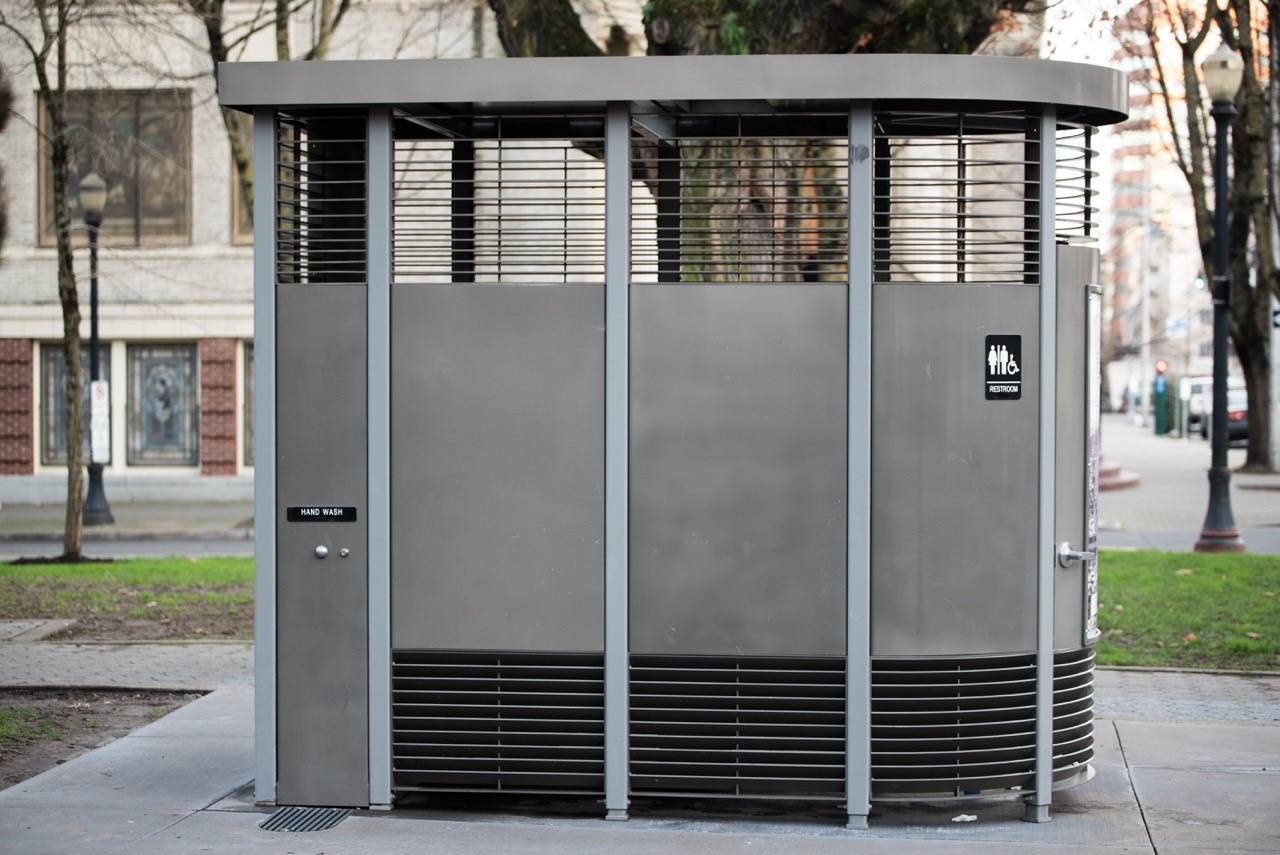
The result, an austere single-occupancy modular restroom with a “prison-grade” stainless steel toilet bowl, is called the Portland Loo, and it’s helped Portland rise to fourth in the public restroom rankings (with 37 restrooms per 100,000 residents).
“In crime-fighting fashion,” the website touts, “the Portland Loo is built to deter unattractive behavior. Damage and graffiti-resistant walls prevent vandalism, blue lights limit intravenous drug use, and the open-slat design alerts public officials to any untoward activity.”
With distrust centered in their design philosophy, it feels an apt metaphor that people have compared the Loo to a gorilla cage, referencing the anti-privacy slats that comprise at least a third of each unit’s 8.5-foot walls. In some places, the solid part of the wall is only about four feet tall. The slats do provide airflow that’s necessary for a capsule model, but the Loo website makes its slat-based priorities clear, bragging repeatedly about how easily restroom users can be monitored. Let’s compare this to the City’s current all-gender restroom requirements, which aim to “prevent any visual observation from the outside of the partition enclosure”: stall partitions must stretch from floor to ceiling and doors, which must be at least seven feet tall, are allowed a minimal gap (up to four inches) at the top and bottom of the door.
If you feel uneasy about the Loos’ lack of privacy, well then you might just be too American, according to one of the designers: “We in the U.S. have yet to shed our puritanical roots,” designer and city commissioner Randy Leonard said. “We are uptight about toilets.”
Nevertheless, the Loo has helped Portland claim fourth place in the public restroom rankings (37 restrooms per 100,000 residents), and now commercialized, Portland Loos have popped up in cities across the US, including in Seattle (one each at Rainier Beach Playground and Ballard Commons).
Modularity has been a huge part of the Portland Loo’s appeal, with the cost and time savings especially apparent for early adopters: a 2017 presentation touted a built-to-order turnaround of 45 days at just $90,000 per unit. Now, the sticker price for each Loo is about $185,000 — but when you add on installation costs, the final bills vary widely: the single Loo at Ballard Commons cost Seattle $550,000 in 2019, New York City’s bill came out to $1 million each for five Loos in 2025, and San Diego installed two Loos in 2015 for about $250,000 each (roughly the same amount Jost and Davidson spent on the MV John F. Kennedy).
It’s challenging to truly determine what a “good” price for a restroom is, in part because there are so many variables: installation costs can be influenced by everything from geography and topography to this year’s (or week’s) tariff prices, and high usage likely means a restroom is addressing a need, but may come with higher maintenance costs. Shorter construction time may cut down on uncalculated bureaucratic and project management costs, but it’s impossible to know how long an initial investment might last. Due to “cost and community complaints,” for example, San Diego closed one of their Loos within a year of installation (don’t worry, they’re still ranked 13th for public restrooms with 26 restrooms per 100,000 residents).
Some people swear that Loos are the solution to the public restroom problem, but they seem to promise more than they can provide: despite touting low and inexpensive ($15,000 per year) maintenance, manufacturers recommend cleaning each unit 2-5 times a day, a tough ask when a recent study of Seattle Parks found that we’re failing to thoroughly clean current Parks restrooms even once a day. It’s no wonder Reddit had a field day with how fully Seattleites managed to denigrate the Ballard Commons Loo.
Exploring Other City-specific Solutions
This finally brings us back to the award-winning restroom at the center of that Weekend Update joke. Designed by local architecture firm 1100 Architect for the New York City Department of Parks & Recreation, the Luis Lopez Playground Modular Public Restroom is a prototype with the goal of constructing replicas across New York City (ranked 60th, with 8.4 restrooms per 100,000 residents).
When construction on the building wrapped in March 2024, the replicability is what drew the American Institute of Architects, New York chapter, to recognize it for Outstanding Architectural Design: “We loved that its impact is much bigger than one park,” they explained. The plans even came with a range of tile colors for facade personalization across neighborhoods.
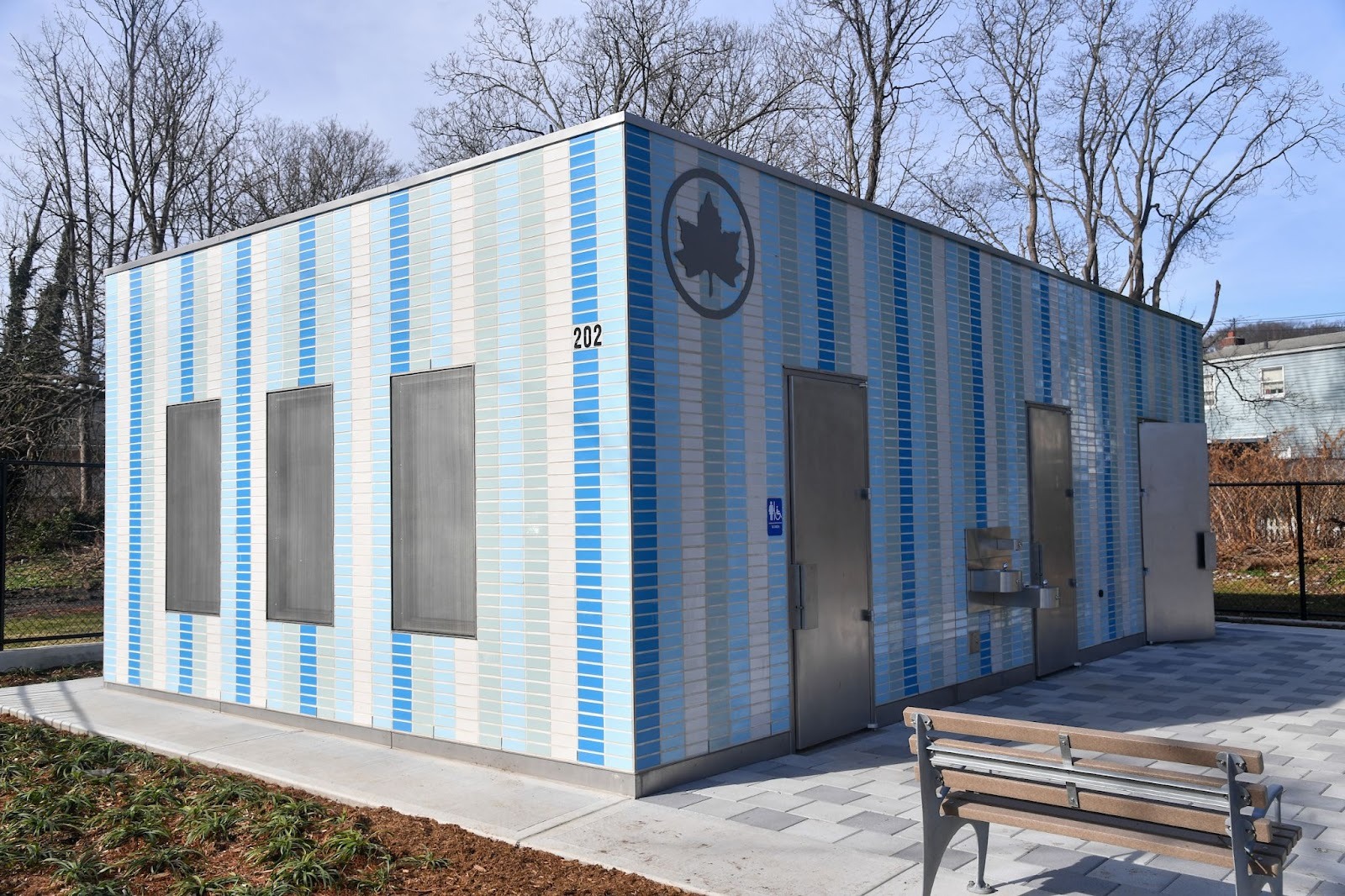
Standing at one end of the playground, its facade of blue-and-white brick is surprisingly cheery, especially compared to the austerity of JCDecaux’s automated toilets and the Portland Loo. Its design goals are similar to those models — low maintenance and “vandal-proof” restrooms with an expedited construction model (and possible cost savings) — but the execution feels different. With white tile walls, the inside feels brighter than the dull metal of the stainless steel capsules, and while small stall walls mean privacy is sparse inside the two gendered rooms of the restroom, having a full wall between where you do your business and the sounds of the playground balances with most expectations of a public restroom.
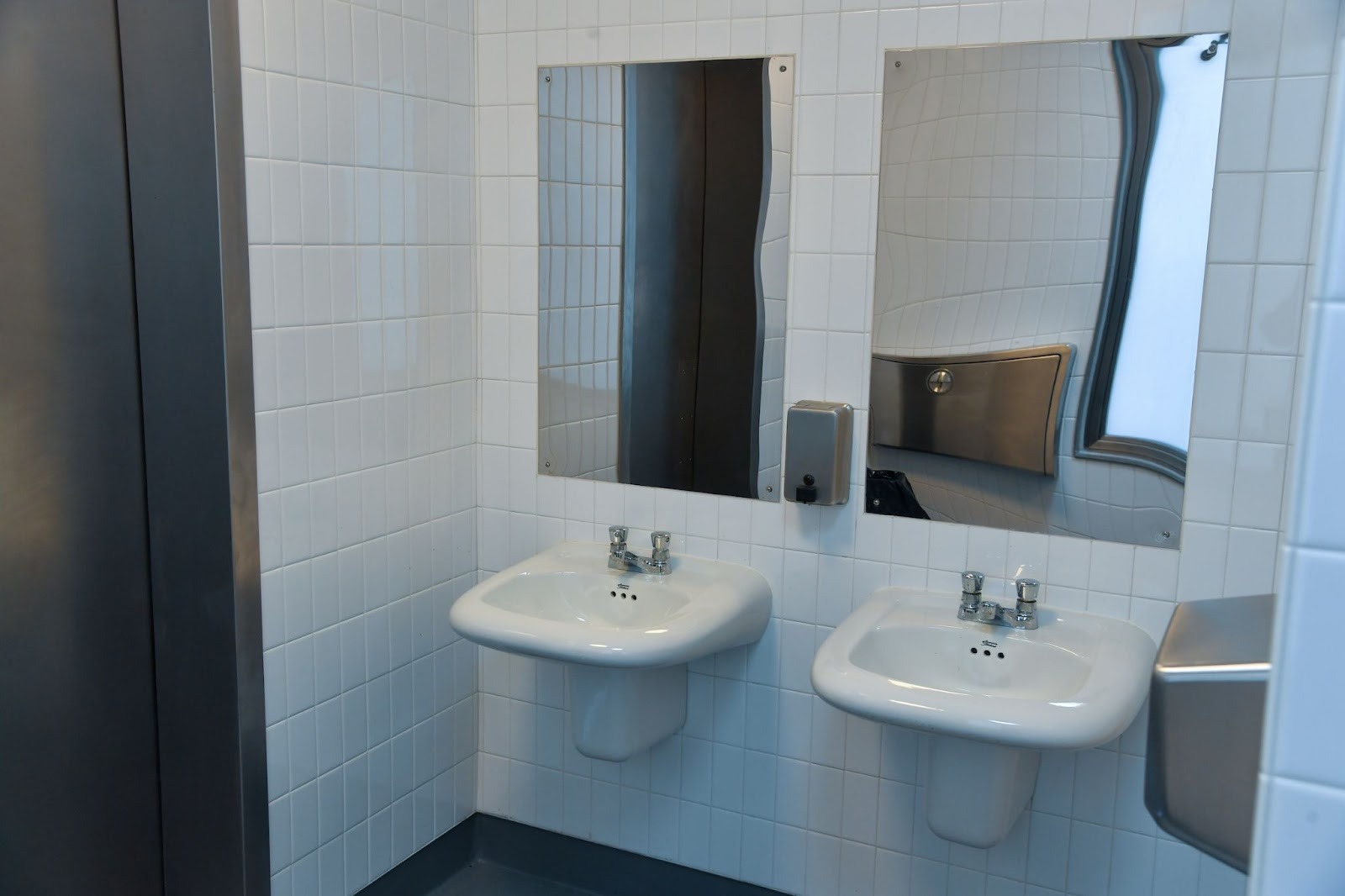
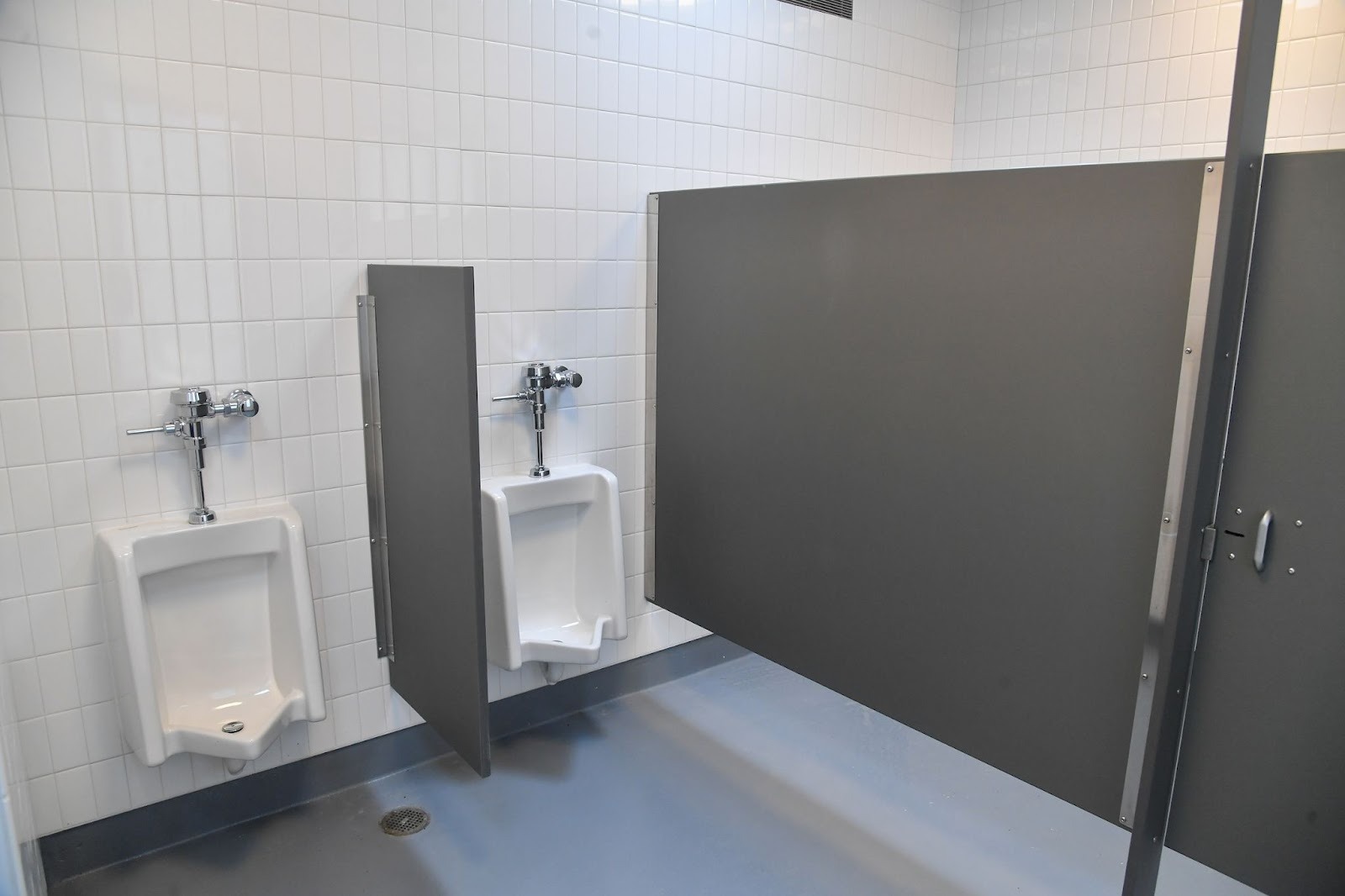
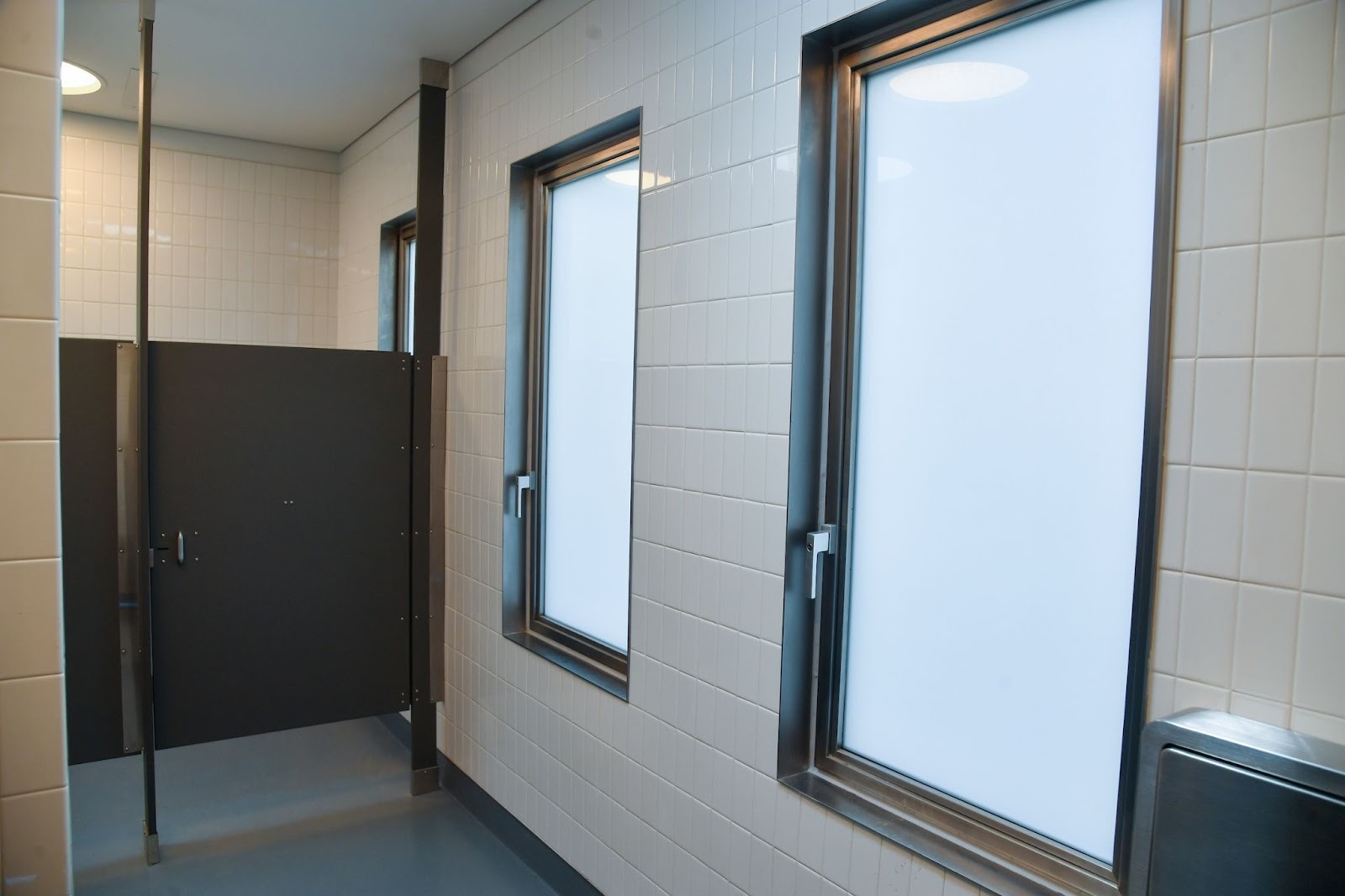
But it doesn’t come without trade-offs: while JCDecaux and Portland Loo built restrooms that are intended to be open 24/7, the Lopez Restroom was likely built with the knowledge that most NYC Park restrooms close at 4 p.m. Limited hours are a classic way for public restrooms to try mitigating wear-and-tear — and usage overall. This is perhaps a realistic look at the City’s capacity to clean and maintain restrooms, but solutions like limited hours serve a limited part of the population. There is now a restroom available for just a fraction of the day, at a time when many other restrooms are available and when many people are otherwise occupied at work or school, leaving a critical five hours before the park’s 9 p.m. closure — which might just be part of the point.
Still, reviews seem to be positive, and plans are in the works for installing the next few iterations of the prototype — likely with a smaller price tag than the $3.8 million original. For a cost analysis, the Lopez Restroom is most often compared to a Bronx park’s restroom that was finished a few years earlier at nearly half the price, but also at half the pace.
An apt comparison here in Seattle was built as part of last year’s waterfront renovations and does not appear to be modular. The all-gender six-stall restroom cost about $300,000 per stall (a $1.8-million total investment), rivaling the cost per unit of popular modular options. (Generally open until 7 p.m., the restroom is staffed by local nonprofit Friends of Waterfront Park, the nonprofit partnership itself a potentially compelling model for cities.)
But New York City doesn’t seem satisfied with their solutions yet: Their forthcoming citywide pilot is looking for a consultant to construct and maintain new modular single-occupancy public restrooms. The call from Mayor Mamdani’s Office includes a long list of hopeful traits, from technological systems for unlocking doors to 24/7 access, with the expectation of a fall roll-out. Other cities may be waiting to see how this plays out, but Seattle is already flirting with a model that could bring Mamdani’s goals to Pioneer Square by summer.
Thrones for Everyone

The Seattle Department of Transportation (SDOT) plans to install two new modular units called Thrones. With a large toilet icon and “Free Bathroom / Baño Gratis” emblazoned on the sides, each cube-shaped Throne stands out for those in need.
Their language stands out, too: their model is rooted in “provid[ing] delightful and dignified places to go,” and their values include cutesy phrases like, “Be loveable,” “Transparency is royal,” and “I ♥ toilets.” Even the name “Throne” looks to playfully elevate the concept of a public restroom.
Rather than a palace, one writer likened the inside to “a Pottery Barn bathroom on Mars.” With fully enclosed sides, mechanical ventilation systems ensure that privacy doesn’t come at the expense of air quality, and like JCDecaux’s self-cleaning toilets, the doors automatically open after ten minutes. Balancing bold design with ease of repair, the palm frond wallpaper that fills each single-occupancy unit can be replaced leaf-by-leaf if graffiti pops up, and fixtures like the toilet and sink were designed for easy replacement — perhaps because Throne itself is responsible for ongoing maintenance. Digital user ratings hold Throne accountable for keeping the restrooms in good repair. After all, why would cities or VC firms invest in something with poor user reviews?
To ensure higher standards of cleanliness, SDOT shared that they’ll opt for the “highest level of care package” to receive four daily cleanings. Deep cleanings will take place between 11 p.m. and 7 a.m., when the restrooms will be closed. (Evening closures, of course, leave a critical service gap that will likely be disproportionately borne by those experiencing homelessness.)
To access the restrooms, users can scan a QR code, text a code on the Throne, or scan a key card (which are often distributed at public institutions like libraries). While 98% of Americans own a cell phone, there may still be barriers to entry, particularly in service-poor areas, for older adults or younger children who don’t have phones or have challenges texting, and for those of us whose phone batteries are accustomed to running on empty.
%20(4%20of%2024)%20(1).jpg)
Despite these potential challenges, Thrones have found avid fans in their communities. In Washington, D.C. (ranked 30th, with 16 restrooms per 100,000 residents and home of the first Throne), when the City’s contract lapsed due to budget cuts, the restrooms closed — but the pilot had seen such success that community members rallied around the cause, calling on the Mayor to reinstate funding. While costs for units have not been shared, each Throne in D.C. reportedly cost $85,000 per year, without any up-front costs.
Here in Seattle, residents, business and property owners, and nonprofits alike attended Wednesday morning’s Pioneer Square Preservation Board meeting, where SDOT presented their plan. During the public comment period, everyone seemed to agree that Pioneer Square needs restrooms, but where some shared unconditional support for the plan, others urged the board to pursue further studies to ensure perfect site selection and fit with the neighborhood’s historic character.
“Anticipating an incredible crush on [their] resources” during the World Cup, the Klondike Gold Rush National Historical Park Seattle Unit (which provides my own go-to public restroom in Pioneer Square) captured one perspective in their public comment as they referred to rowdy (and sometimes drunk) fans, perhaps even thinking of the damage Pioneer Square’s historic pergola sustained after the Seahawks’ Super Bowl win this year. “We do have a history of nuisance behaviors happening. At the same time,” they stated, presumably referring to how urine can damage historic buildings, “Not having the bathrooms can be a preservation issue in the district. So those are carefully balanced things.”
The Pioneer Square installations will be a one-year pilot funded by the 2026 Seattle Transportation Levy, with King County, Sound Transit, and Pierce Transit running similar pilots simultaneously, and Wednesday’s presentation came after a nearly year-long community engagement and research process. As SDOT’s Public Space Manager Joel Miller shared during the meeting, “This is happening, in Seattle time, at a pretty quick pace.” But as SDOT emphasized in the presentation, the flexibility and mobility of Thrones mean that if they choose the “wrong” location initially, it’s an easily reversible mistake. The pilot itself is part of the research, and as we know, Seattle is no stranger to shortening an unsuccessful toilet contract.
What Comes Next?
This moment feels like a perfect storm and a perfect opportunity to continue trying new pilots: modular solutions continue to expand, the clock ticks closer to the World Cup, our new Mayoral administration has emphasized the importance of restrooms, and Seattle is considering significant budget cuts.
In addition to the new Thrones, the ongoing Westcrest Park Restroom Renovation & Play Area Restoration project, with an $800,000 budget for a prefabricated restroom, is one to keep an eye on. With site analysis and a feasibility study still pending, there’s little public information on the plans, and a budget of this scope may mean going with an existing manufacturer — but even that could open up doors for exploration. Expanding the Throne pilot is one option, but a return to the automated public toilets of the ’00s is of course unlikely, and the Portland Loo may be a familiar option, but it’s one that seems neither to adequately meet Seattle’s needs nor to particularly enthuse Seattleites.
I, for one, hold out hope for innovative ideas that can meet the needs of both the people and the city, foolish as it may be (as Davidson said about the MV John F. Kennedy, “It’s fun to have a dream”). Modular options can be scrappy and creative, just like Seattle itself, and I hope that city leaders will take this moment as an opportunity to refresh our outlook and critically look at why past iterations have fallen short, rather than assigning blame and leading with distrust. Our new Thrones seem like a step in the right direction, especially for a short-term solution.
For the long-term, as we’ve seen, buying an existing model is no guarantee of success, and the tab can add up regardless — sometimes the automated toilet or decommissioned Staten Island ferry that felt full of potential when you bought it turns out to cost exponentially more than you ever imagined — so why not live a little? At least we know that whatever route we go, it won’t involve docking fees.





.jpg)

.jpg)