
Transforming a curious exploration into an integrative strategy, artificial intelligence (AI) has reinvented itself as a part of design and technical workflows as opposed to being a task-assisting tool. As technology advances rapidly, conversations around the possibilities of AI also amplify across industries and their domains.
The architecture, engineering, and construction (AEC) industry is no exception with its dialogue shifting from “Do we adopt AI?” to “How can we ethically incorporate AI into our existing frameworks?” What’s fascinating is how design and infrastructure firms are interpreting the use cases of AI in an ever-evolving urban scenario. From leveraging digital-twins and city simulation models for analyzing user circulation patterns, transportation networks, and assessing real-time data, to generating iterative and climate-responsive designs—AI has merged its predictive ability with creative productivity.
The recent seminar “Architecture in the Age of AI” hosted at the University of Washington campus explored the transition of AI shaping industry practice, addressing questions and concerns alike. Moderated by Tomás Méndez Echenagucia, Associate Professor in the Department of Architecture at UW, the discussion emphasized that architecture is fundamentally human-driven. While AI can accelerate design and technical processes, the creative intent, critical thinking, community interaction, and storytelling remain with the architects. Gatekeeping a sense of empathy, identity, and cognitive association, the creatives direct AI to investigate, manage, synthesize and convert data into solution-based outcomes that increase project and workforce efficiency.
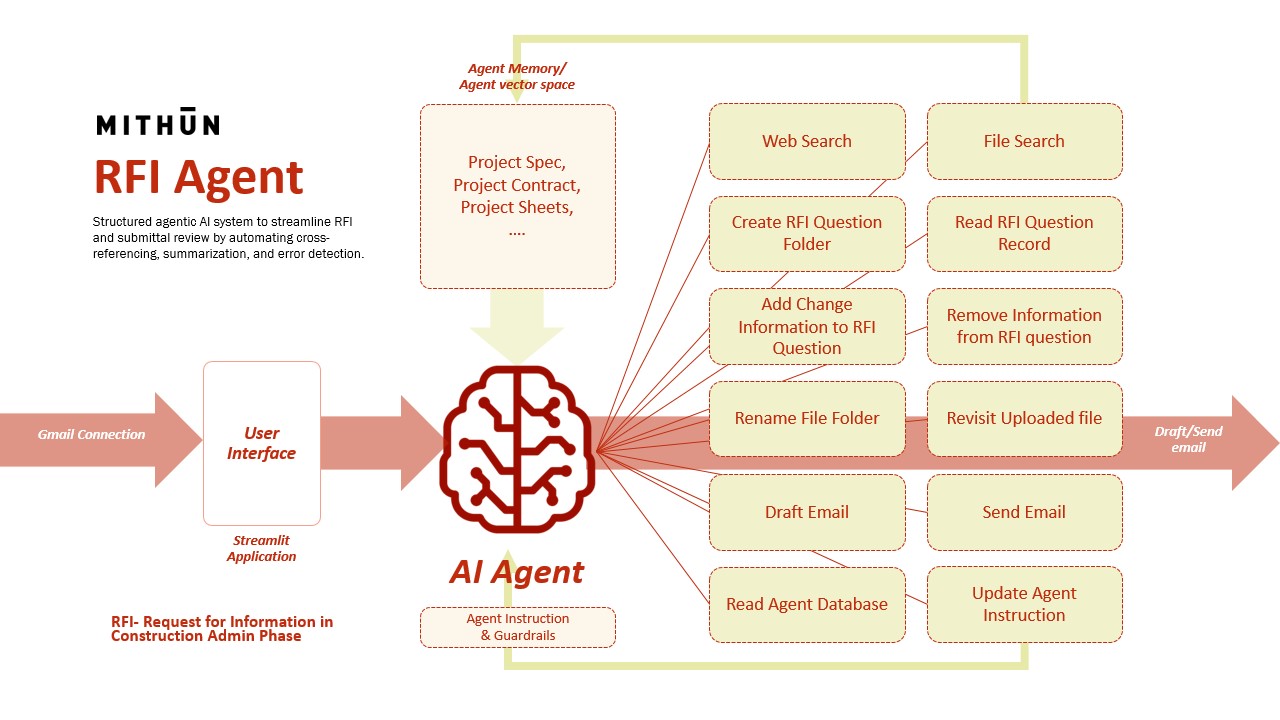
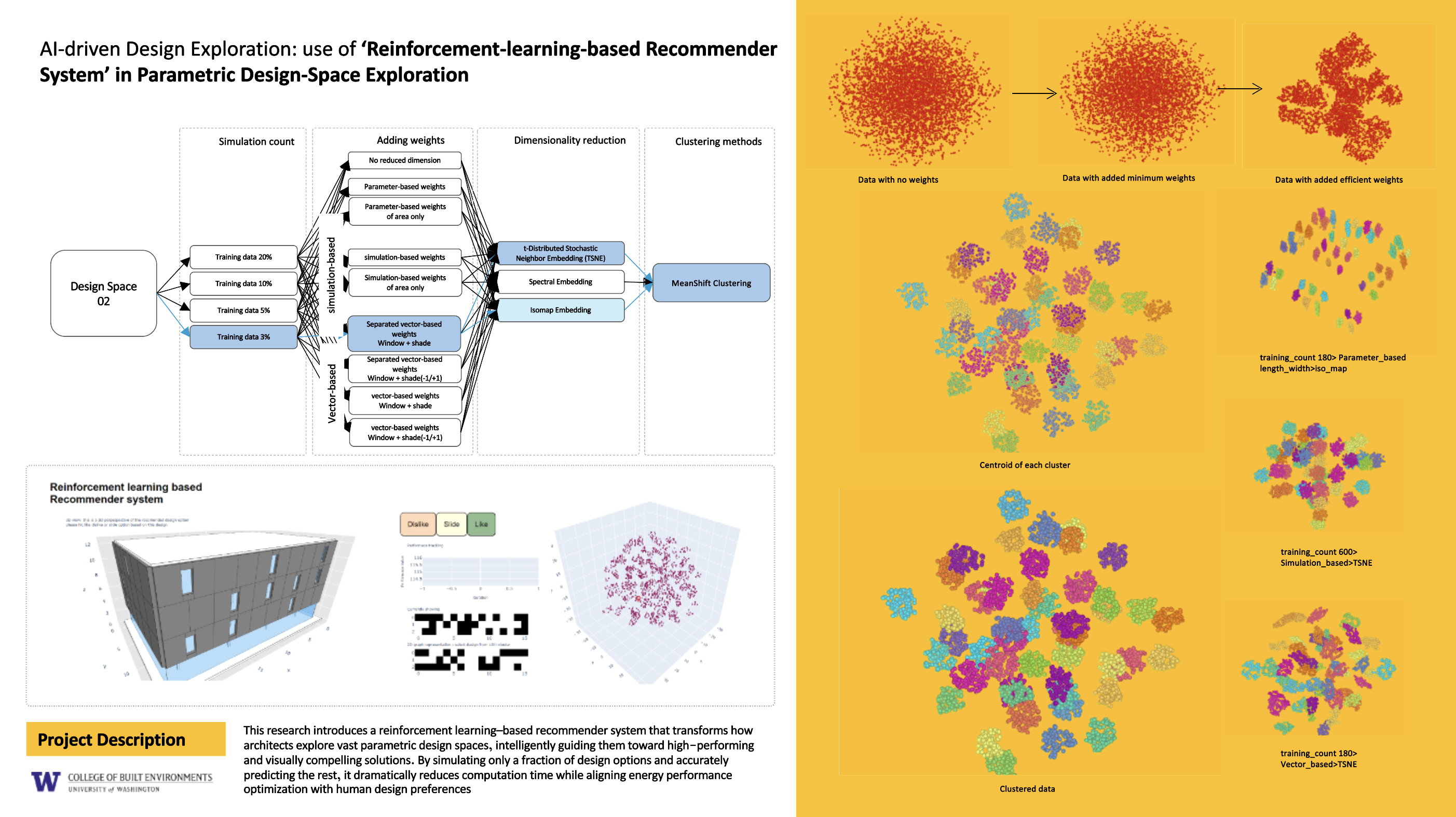
Panelists Chris Grammens (Associate/BIM Manager, Miller Hull), Blair Payson (Principal/Owner, Olson Kundig), Md Shariful Alam (Associate/Computational Designer, Mithun), and Simon Manning (Associate/Design Technology Integration Leader, NBBJ) shared their thoughts on AI experimentation, research, and algorithmic interdependency. One of the many compelling ideas discussed highlighted how AI should function as infrastructure rather than being a tool. Layering the varied components of AI into Building Information Modeling (BIM) will enable its use within project workflows. The seminar also observed a pattern in the evolution of the AEC industry wherein a new software has historically replaced a former one, altering design systems and skill sets altogether. However, AI is not here to replace, but to weave into existing structures and simplify them further.
Revealing their earliest interaction with AI in design, some of the panelists spoke about creating visualizations in Midjourney, following a text-to-image format, and presenting concepts for pursuits and competitions. Closing the gap between innovative ideas and accurate design representation, AI tools like Midjourney and Nano Banana Pro (sketch-to-render interface) help professionals enhance visual narratives and test design directions while democratizing creativity. While many of the panelists advocated a positive outlook on AI’s role in industry practice, complex questions surrounding authorship, data privacy, data security, and professional development raised concerns.
According to AIA’s March 2025 report, a study states that only 6% of AEC firms regularly use AI while 8% have incorporated AI-powered solutions into their practices. Global AEC giants like Gensler, Foster + Partners, Zaha Hadid Architects (ZHA), Bjarke Ingels Group (BIG), Kohn Pedersen Fox (KPF) and many others actively implement AI to optimize energy efficiency, structural performance, analyze user behavior patterns, elevate parametric design, and integrate smart technologies amongst other functions. As one of the industry’s infrastructure leaders, AECOM uses its own internal digital tool called BidAI for streamlining and improving proposal curation, coordination, and bidding process—providing strategic collaboration and easy access to project data globally for winning business through competitive advantage. Additionally, the firm has also launched an AI Innovation Center in Singapore to map their underground transit system, creating more employment opportunities in the process.
As AI swiftly shape-shifts to its progressive versions, it is not merely enough for AEC firms to adopt the technology. Conceived as a future-forward tool that is altering the present each passing day, AI is evidently here to stay and has to be punctuated within design systems. It is paramount for firms to invest in AI resources, training programs, upskilling workshops, and AI-focused teams—all of which allow architects, engineers, marketers, and project managers to collaborate effectively and flexibly adapt to the changing dynamic of the design industry. The idea is for AI to catapult project performance, automate tedious tasks, reduce errors, and improve profitable gains, none of which should come at the cost of replacing current employees who have spent years perfecting the varied skill set that still continues to drive AEC firms.
Reinforcing the fact that design requires human thinking, problem-solving, spatial reasoning, decision-making, and imaginative abilities, AI in the AEC industry should primarily focus on augmenting processes. While architects remain the curators of design intelligence, AI can strategize workflows. Circling back to the seminar, the panel talked about how AEC firms are waiting for AI to mature in order to reshape their stance around it. A major challenge for architecture firms is data organization and security, especially when sensitive information and layouts concerning civic and government projects are at stake. Referencing the medallion lakehouse architecture, data maturity levels like Bronze (raw), Silver (refined and validated), and Gold (business-ready) serve as an efficient base point for firms to reorganize and segregate their data through automation and agentic AI.
Another concern that stands out is how embedding AI within workflows can subtly shape the design thinking of architects, influencing their methods and subsequent outcomes. Preserving the collaborative process of brainstorming ideas as a team, the simplicity of sketching and hand-modeling to unfold design direction, and conducting user-surveys physically is also equally valuable, if not more. AI certainly guides architects to orchestrate digital systems, however, this transition redefines authorship in ways that the industry isn’t fully positioned to confront. On that note, it is highly necessary for firms to ethically employ AI by governing policies and laws around data privacy and copyright infringement.
It is a well-known fact that young professionals in the AEC industry are often overworked owing to the tedious demands of the profession, spending formative years drafting drawings, formulating documentation, coordinating technical checks, modeling design iterations, and engaging in repetitive tasks—all while resorting to doses of caffeine for sanity and stress relief. If introducing AI significantly eases the burden and lets AEC professionals focus more on creative exploration and technical innovation, it is only reasonable to accept and adapt.
For as long as creativity finds its own path to flow, and is not steered by AI, rather supported by it as a true companion along the journey—architecture will continue to exist as a deeply human endeavor.
The author acknowledges Chien-Yi Chu (AIAWA Associate Representative 2024-2025) as a Resource Contributor for sharing her valuable seminar notes.





.jpg)

.jpg)