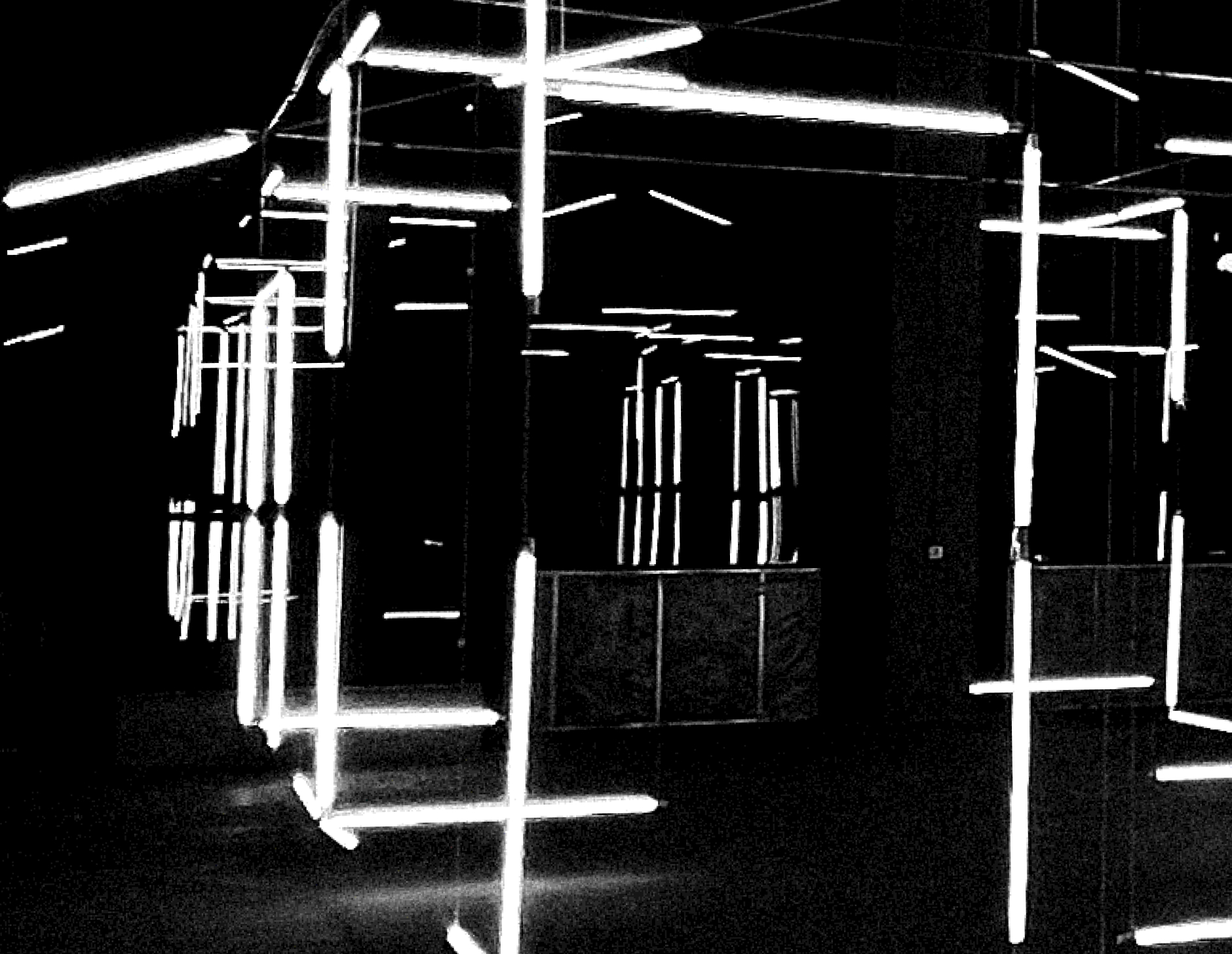
On Friday of this year’s Seattle Art Fair, a weekend where there are multiple satellite activations throughout the city (especially in Pioneer Square), Ben Zamora opened “In A Dream You Saw a Way to Survive” presented by The Factory and Timothy Rysdyke. Zamora’s installation is a full-size immersive piece which fills an empty office space on the ground floor of The Jack. In Zamora’s words: “This project is a full-scale, walk-through sculptural installation that reconstructs my childhood home entirely from linear tubes of light. Walls, doorways, hallways, and thresholds are rendered as luminous line drawings in space. This dives into themes of memory, perception, and identity… allowing inaccuracies, distortions, and omissions to remain.”
The concept of such a piece feels simple enough: Zamora reconstructed his childhood home in such a way so that the viewer can navigate the layout as a representation of where Zamora grew up. But even as I write this, almost two weeks after I walked through “In A Dream You Saw A Way to Survive” I am left with feelings of deep nostalgia. The last time I saw an installation that truly stuck with me was when Julia Greenway ran Interstitial and showcased the now internationally famous Wong Ping’s, Who’s The Daddy. That piece, and I believe Zamora’s as well, will continuously leave me feeling deeply rooted to the value of art.
The importance of Zamora’s piece is less about the experience of his recollection, but about the imposition of our own. Our memories are leaving us constantly - physiologically, we are inherently unreliable as memory holders and as we incorporate constant digital documentation, AI to answer questions we cannot recall answers to on our own, Alexa and home devices setting reminders and telling us when to pay bills or buy groceries, the necessity of our already fleeting memory has become obsolete. Zamora’s recreation of his childhood home became for me a placeholder for my own recollections and the significance of the erosion of time. Time creates gaps for us all, represented so clearly in the spaces between the poles and lights.
Admittedly, the scale of the recreation (or representation) of his home is off, the rooms are standardized, the entrance is to the side of the gallery facing the window, not directly in front of you. I was not able to imagine the facade or the yard or the color of the front door as there was no reference material available to impart such indications. Instead I found myself inputting all of those details from my own life. Zamora’s work forced me to recall the gate and gravel on the front steps leading to my front door, the time I hollowed out a bush in the backyard and slept there wondering if anyone would notice, the heat rising from the sidewalk and intensity of the cold air from the swamp cooler when you walk inside. The back room of my childhood home had a small TV on which I would watch cartoons early in the morning. The sliding glass door led to a small strawberry patch… I could go on.
I imagine that not every visitor will have such an ephemeral experience with this piece by Zamora, but the opportunity is there nonetheless. He created something for himself, deeply personal and deeply methodical, that serves as a canvas for our own recollections and experiences. I can think of no better work of art than one that achieves such a service to the viewer.
Your last chance to see Zamora’s work is this coming August art walk at The Jack.
“In A Dream You Saw A Way to Survive”
By Ben Zamora
Presented by The Factory
Closing August 6th 5pm - 9pm
74 S Jackson St, Seattle, WA 98104


.jpg)

.jpg)