The shorthand directions provided to Julie Alpert’s Seattle home studio do more than just guide you to her doorstep—“Blue house, yellow door, pink chairs”—they offer an immediate and distilled glimpse into her iconography. Crossing the threshold, it becomes clear that this vernacular is the entry point to a workspace where nostalgia and domesticity are continually disassembled and reimagined. Inside, playful intentionality follows you down to the floorboards, where her three cats (Coconut, Koala, and Baby Cloud) navigate a world that includes a low-hanging gallery wall mounted perfectly at feline eye level.


Alpert’s acute attention to detail is rooted in the quiet, observant habits of her childhood. A routine of daily walks, noticing the static “leaf poses” of plant life, and the specific anxiety of a seven-year-old stressed about permanently adhering stickers to a page in the “right” composition. Alpert channels this lifelong instinct for gathering and noticing into creative constraint: a fixed palette of seventeen custom colors extracted from the 1950s through ‘90s landscapes of her parents' and grandparents' homes. The mid-century hues—"ugly" mauves, muddy avocado, brick, and ochre—become the visual language through which she creates a very specific tension: a nostalgia for the beautiful that is simultaneously icky and unsettling.

When Alpert’s philosophy is scaled to the fifty-foot dimensions of her recent work at Seattle-Tacoma International Airport, commissioned by the Port of Seattle, the quiet act of collecting transforms into a sprawling, non-linear narrative. Each motif twists and turns around the airport's existing structure, morphing around air vents and piping to create a stream of consciousness informed by girlhood.

At the heart of Alpert’s hand-painted reliefs is a deliberate relationship with light. In her intentionally windowless studio, she operates like a set designer, using the enclosed space to craft drama and focus through faux, hand-painted shadows. For Alpert, light is a medium built directly into the creative process, rather than an installation afterthought. In the grand, bustling terminals of SEA, translating that intimate studio control requires a thoughtful bridge. Installed high on the baggage claim walls, twelve feet in the air, her fifty-foot sculptural reliefs—Souvenirs at Carousel 16 and Raindrops on Roses at Carousel 13—live in a vast public space filled with competing overhead illumination and uneven shadows from airport equipment.
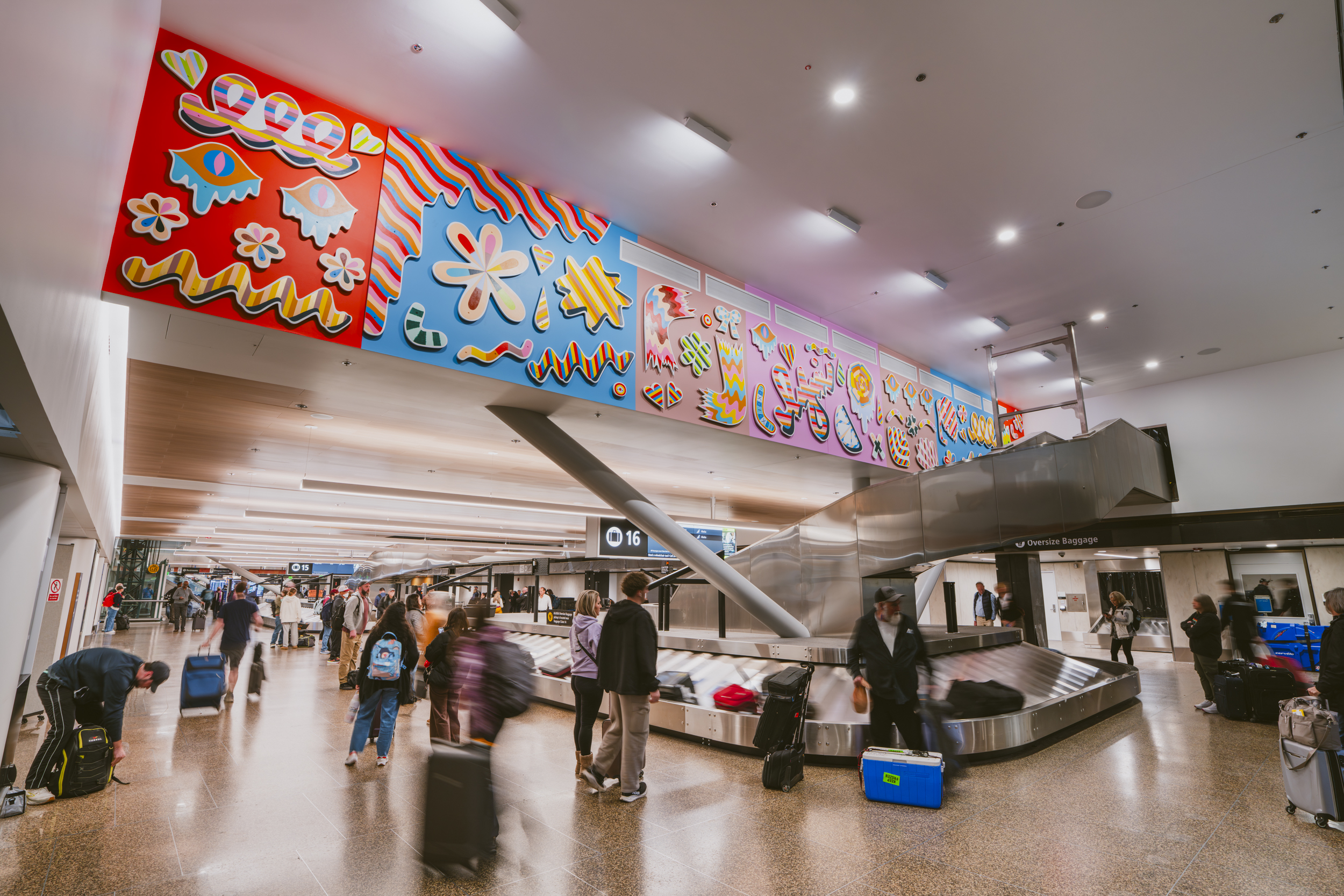
For an artist who treats light as a primary medium, collaborating with the architect-appointed lighting firm, Blanca, was a critical step. While Alpert had a precise vision for the final effect, she noted the technical gap: “I knew what I wanted to achieve, but I didn't know what questions to ask or how to get there.” Blanca, a full-scope lighting design studio known for complex civic, university, and historic renovation projects, sat with Alpert to address her pain points and translate her intuition into a practical, maintainable lighting solution. Composed of multidisciplinary artists, designers, and theater enthusiasts, the Blanca team was uniquely positioned to guide a fellow creative across the finish line.
The nuance of color temperature dictated how Alpert’s motifs popped in the layered environment. The photometric calculations (the science of measuring light) by Blanca helped determine the precise fixture locations, beam spreads, and lumen output to reduce unwanted shadowing and provide the most even illumination across a collective 103 feet of wall space.

"The project presented a unique set of challenges," notes Blanca founder Lucrecia Blanco. "We were navigating a dense forest of equipment shadows and the inherent complexity of the art’s own vibrant colors and deep shadows. Added to that were the Port’s strict specifications for fixture locations and the immense speed at which decisions had to be made as the project moved forward. In truth, for the Blanca team, it was a respite to work with Alpert and the other artists. Their perspective on the space and their willingness to collaborate was incredibly rewarding."
By treating the lighting as a creative extension rather than a technical afterthought, the team ensured the art remained sharp and deliberate against the surrounding airport. For the passerby, the baggage claim becomes a place to notice rather than just wait; an experience that mirrors the quiet, observant habits of Alpert's own process. Ultimately, the project scales the intimacy of her home studio into the public realm: a vibrant, precisely lit invitation into her fantasy world of nostalgia.



.jpg)

.jpg)