From the Indian veranda to the Italian loggia, the Japanese engawa to the Haitian galri, the porch is an age-old architectural strategy present across cultures and climates. It’s a buffer space that shields from the elements in cold climates, and a means of ventilation and shading in hot, humid ones. A transitional space, the porch facilitates the passage between public and private; simultaneously, it can be a welcoming place for social interaction and relaxation.
At PORCH: An Architecture of Generosity, the US Pavilion at the Venice Biennale, explores how this space is quintessentially American and inherently generous. Nearly 400 design teams from around the country reflected on the meaning of the porch in their own work. Ultimately, fifty-four finalists, three of which are based inSeattle, were selected to represent the US. As America’s perception abroad falters, the contributions of Seattle architects The Miller Hull Partnership, atelierjones, and Olson Kundig offer a story of generosity and optimism.

La Biennale di Venezia, or colloquially “the Olympics of the art world,” is an international art exhibition that’s been held in Venice, Italy, since 1895. The festival’s focus alternates between art and architecture, with 2025 marking the 19th Biennale Architettura. In the southeast corner of the island, the park-like Giardini is the festival’s original site and features the Central Pavilion and numerous national pavilions, including that of the US; adjacent, the pre industrial ship-building center known as the Arsenale hosts various special exhibitions and more country pavilions. Curated by architect and engineer Carlo Ratti, this year’s theme, Intelligens. Natural. Artificial. Collective., urges designers to draw on different types of intelligence to redefine how the built environment addresses today’s most pressing issues, especially climate change. To participate in the Biennale is to peek into the most creative and innovative minds around the world.
The decision of co-commissioners Peter MacKeith of the Fay Jones School of Architecture + Design at the University of Arkansas, Susan Chin of DesignConnect, and Rod Bigelow of Crystal Bridges Museum of American Art to focus on the porch seems fitting given the opening of Ratti’s curatorial statement for the Biennale at large: “Architecture has always been a response to a hostile climate. From the earliest ‘primitive hut,’ human design has not only been led by the need for shelter and survival, but also driven by optimism.”
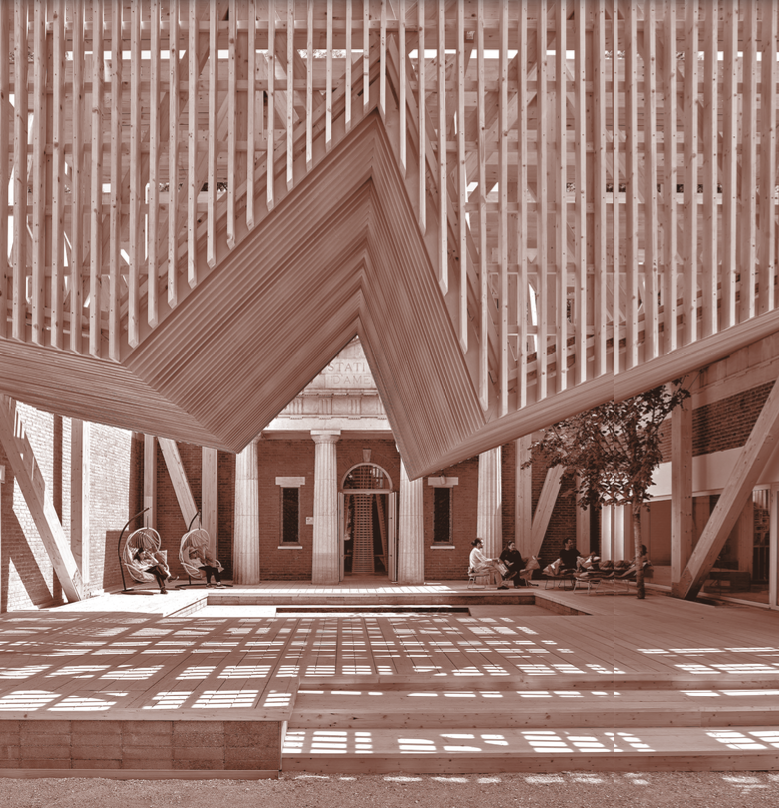
The fifty-four models—one for each design team—are exhibited in “window boxes” in the interior of the permanent US Pavilion building, a 1930s neoclassical structure. Outside, Marlon Blackwell Architects, TEN x TEN, Dirt Studio, and Stephen Burks Man Made transformed the front courtyard into a contemporary porch. The dynamic, zigzagging wooden structure hosts a myriad of artistic programming, enlivening the space. “It was the heartbeat of the Biennale,” says Brian Court, principal at Miller Hull. “They had live music, they had dancing, they had all the people, and they had this great porch.” The US Pavilion may be the exhibition’s heartbeat, but Miller Hull’s submission draws equally on this cardiac metaphor.

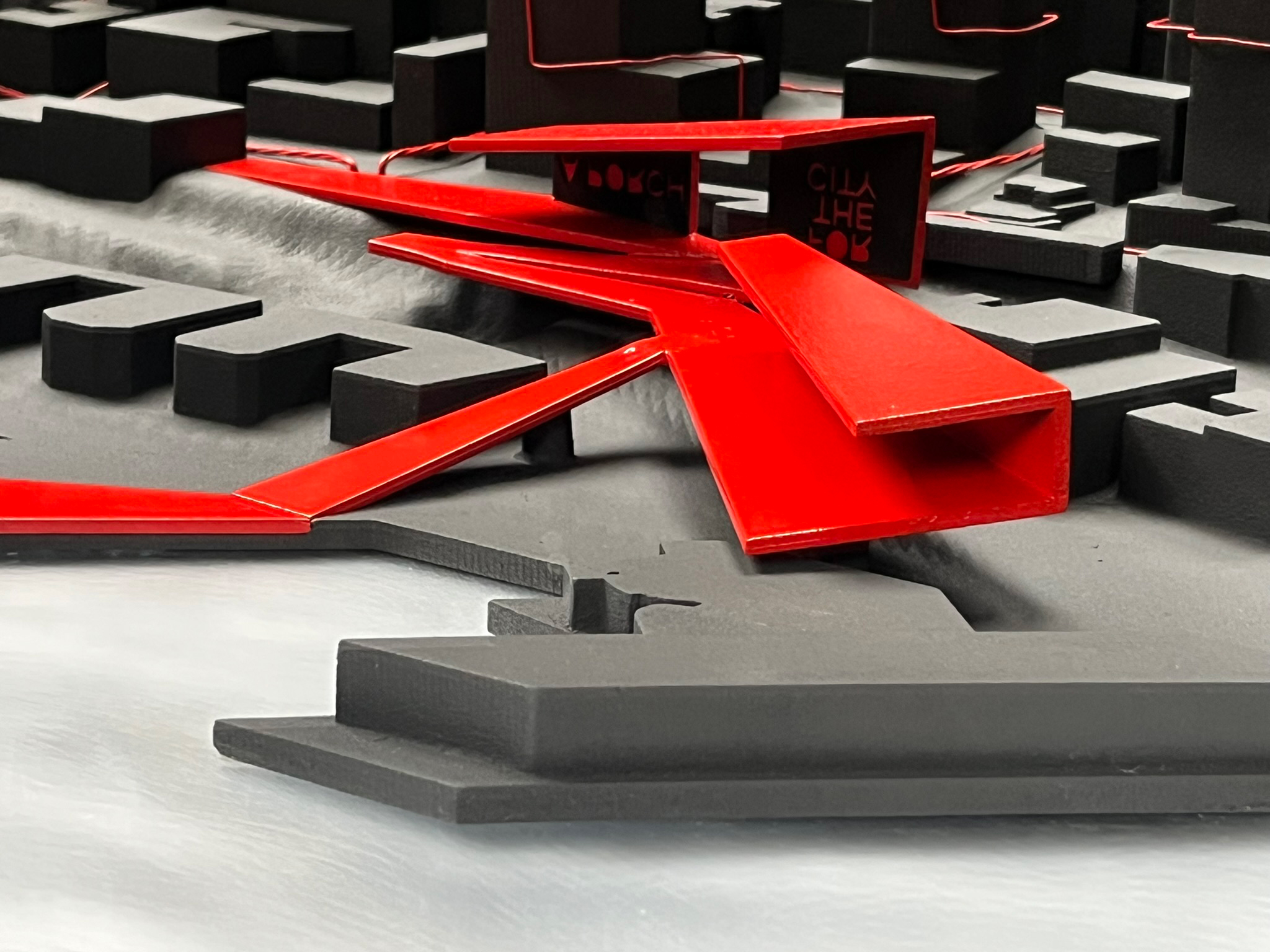
The MarketFront project—essentially a “porch for a city,” notes Court—is the threshold between Seattle’s historic Pike Place Market and the recently redeveloped waterfront. The bright red abstracted form of the model connects to the rest of the city by thin red veins, alluding to people’s circulation from the office, home, or street to the community-centered market. The box’s mirrored walls create “interesting perspectives of the MarketFront building itself [as it is] reflected through the context of the city,” observes senior associate Cory Mattheis. Why red? Well, it’s “Market red,” of course—a callout to the iconic Public Market sign. Though completed in 2017, MarketFront is particularly relevant for Seattleites today. For the first time, the city’s downtown is connected to the waterfront via the Overlook Walk. Opened in 2024, it bridges the 100-vertical-foot gap and brings pedestrians down to the 20-acre Waterfront Park, completed in collaboration with James Corner Field Operations and LMN. Mattheis notes that while the MarketFront was once about “arriving, pausing, and looking out over Elliott Bay,” now it’s an energetic node of movement and transition. Like a porch, it’s both a place of prospect and refuge, and a threshold.
“It was one of the honors of my lifetime,” says Susan Jones of atelierjones, who first visited the Biennale in 1990 as a young architect and has since regarded it in her own mind as a “North Star.” For the Maidu Roundhouse Youth Education Center, an after-school center in Greenville, California, the atelierjones team worked closely with the Roundhouse Council and Sierra Institute for Community and Environment to replace an after-school center destroyed by the 2021 Dixie Fire. Its form is modeled off traditional Maidu roundhouses, but Jones, known for her innovations in mass timber, uses 10 ′ x 4 ′ cross-laminated timber (CLT) panels for the walls in the central rotunda. This human-scale acknowledges tribal members’ practice of joining hands in a circle to size the gathering spaces for their roundhouses. The model for the Biennale captures this sentiment well—every other panel is replaced by a human figure. A steel shell surrounds the mass timber structure for maximum fire resilience, while timbers salvaged from the fire make up the porch’s colonnade. atelierjones’s human-centric porch shares the story of one community’s resilience and provides inspiration for communities nationwide.

Olson Kundig took a unique approach, featuring three porches of varying scales in their model. “Every week—for as long as any of us can remember—we’ve engaged in ‘Crit,’ a firm-wide design dialogue,” recalls Olson Kundig principal and owner Alan Maskin. Following the Biennale crits, the team knew this notion of scale was key, and selected three projects from their public portfolio that reflect how the domestic porch is translated. The Fourth Ward Office Building along the Beltline in Atlanta,Georgia, is a 1.1-million square-foot commercial building with offices and ground-floor retail. Six different porch types are present throughout the project, including a large dog trot—an open passageway cutting through the center of a building, typical in southern US residences to provide ventilation, but here creating a plaza that connects the Old Fourth Ward Park and the Beltline Corridor.
The arbor and elevated tree walk at Leach Botanical Garden in Portland, Oregon, draw on a more Pacific Northwest idea of the porch as a protector against rain and cold. The arbor’s wooden screens soften the wind and create a fun play of light and shadow, while the tree walk extends the idea of the porch into the forest as it weaves through trees on the site master-planned by Land Morphology.

Olson Kundig’s smallest-scale porch, 242 StateStreet, a 2,500-square-foot storefront in Los Altos, California, employs one of the firm’s hallmark “gizmos.” The entire front facade can be raised or lowered by a hand crank, enabling the space to shift from enclosed to inviting. “I’ve already noticed in the weeks following the Biennale’s opening that the idea of ‘porch’ has infiltrated our internal design conversations on multiple occasions,” says Maskin. Just as Olson Kundig did, designers across the country can find inspiration for their public projects in the richness of residential architectural typologies, like the porch, which are all about warmth, community, and belonging.
As the administration cracks down on immigration and instates exorbitant tariffs, an architecture of generosity might seem like wishful thinking. Indeed, Maskin reflects, “The one sobering moment for me was realizing that, simultaneous to the US Pavilion’s opening event, many cultural organizations back home were receiving cancellation notices for grants they had been awarded from the National Endowment for the Arts.” However, the contributions of the Seattle firms illustrate how the American people still have faith in the goodness of one another and how architecture is there to elevate this sentiment. “When you left the US Pavilion, there was a sense of uplift, of warmth. A feeling that we can do this together—and that our resources are ourselves and the communities we create,” says Jones.
In the age of rapidly advancing artificial intelligence, the rather humble porch is a return to the analog strategies that have defined building for millennia. One such strategy, present on the pavilion’s contemporary porch structure, is the haint blue paint, a popular tactic in the southern US for keeping away mosquitoes (and evil spirits, which are practically the same thing). Miller Hull architectural designer Tobias Jimenez says, “It’s a means of intelligence that we often forget, that we don’t pass down anymore. It’s a heritage knowledge.” In contrast to the overwhelming digital focus of the rest of the exhibitions, the US design teams’ simple, low-tech approach is refreshing and hopeful.
“The bells were all of a sudden ringing one night. We were standing in the middle of Peggy Guggenheim [Collection] for a reception,” Jones recalls, shivering, as news broke that the first American pope was elected. In that moment at St. Peter’s Basilica in Rome, Pope Leo XIV stepped onto the central balcony—a porch, really—and radiated warmth and generosity. Jones closes: “I have to believe in the hope and the optimism in the choice of the cardinals.”