Everyone’s building something. Tear it down! Build it back! Live smaller! Grow denser! Escape the city! Save the city! Own land! Share land! Garden for self-care! Garden for revolution!
Spend enough time online, and it feels like every civic idea is a lifestyle drop. Every solution has a name, an aesthetic, a counterpoint. But beneath the noise, something slower is taking root. On the edges of cities, in borrowed soil, people are growing things. Quietly. Together.
You’ve probably passed them without a second thought, those patches of green tucked between buildings in cities like Seattle: urban gardens. At first glance, they might seem like nothing more than a tidy row of kale or a few tomato plants in bloom. Look closer, and you’ll find these modest plots hold a deeper truth about how we live together: who gets seen, who finds space, and who is left out.
It all starts with a simple, almost radical question: What if the most powerful civic spaces were planted in dirt?
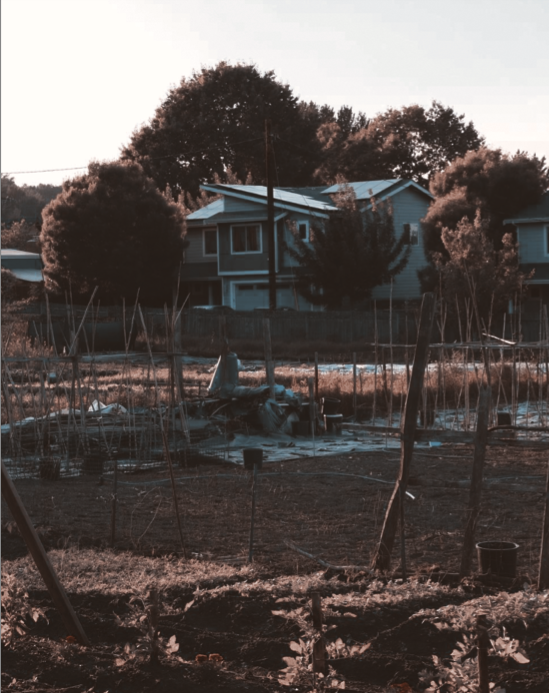
On a quiet Sunday afternoon at Marra Farm in Seattle’s South Park neighborhood, the work is steady. Airplanes pass low overhead, hands move soil. Rows of garden plots, some freshly turned, others already sprouting, stretch across the field. Spring is urgent: plant now or miss the season. A weathered sign, written in English, Spanish, and Chinese, tells part of the story. This land is shared, and it has never been neutral.
South Park sits on the banks of the Duwamish Waterway, a part of Seattle often left out of the city’s narratives. It’s a neighborhood bordered by highways and heavy industry, shaped by decades of environmental neglect. The river here is a Superfund site, polluted by decades of industrial runoff. And yet, South Park has never been passive in the face of these conditions. This predominantly Hispanic community has long resisted efforts of displacement, including attempts to convert the area entirely into industrial land.
Marra Farm stands as a testament to that resistance and to what community care looks like. On any given day, you’ll see families and neighbors working their plots, weeding, watering, and harvesting. Some grow food to supplement their groceries. Others grow to stay connected to cultural traditions or to earn some income. It’s a quiet, collective rhythm that echoes far beyond this field. Across Seattle, nearly 90 urban gardens known as P-Patches foster similar acts of resilience, nourishment, and connection.
To understand the deeper story these gardens tell, we need to look back. Urban agriculture isn’t new. Its roots stretch across time and geography, from Mesopotamia to the victory gardens of World Wars I and II. In the US, waves of community gardens emerged during the economic and ecological crises of the 1970s, when city residents, especially in low-income and immigrant neighborhoods, reclaimed vacant lots as sites of nourishment and resistance. These were grassroots responses to disinvestment and top-down planning, often met with hostility from city governments. And yet, they persisted.
What feels different today is our attention. In an era of civic fragmentation, climate anxiety, and rising social distrust, the garden has returned not just as a trend or nostalgic gesture but as a necessary civic platform. A classroom. A common.
Landscape architect and writer Eric Higbee is one of the voices helping to frame this shift. His work in community-based design sees gardens not as amenities, but as generative civic engines. “There’s something about growing food together where you live that checks all the boxes—connection, health, stewardship, identity,” he says. “Community gardens end up being this engine that just keeps going.”
Higbee describes these spaces as “mini democracies” and, like any democracy, they can be messy, vibrant, and hard-won. Plot disputes. Broken irrigation. Vandalism. Every challenge in the garden demands coordination and care. Gardeners, from South Park to Capitol Hill, define their own rules and resolve conflicts through shared dialogue. In a time when civic processes feel distant or opaque, these gardens offer a model for something different: a participatory design of daily life.
These gardens don’t just happen. Their endurance depends on how they’re planned and governed. “The design phase becomes the launchpad for shared ownership,” Higbee explains. That turns the conventional model of community engagement on its head. In these spaces, process is everything, and it never really ends. “In the ’70s, architecture and planning redefined themselves in response to the environmental crisis,” Higbee says. “We’re facing a civic crisis now. We need a revolution on that scale.”
Elizabeth Golden, an architect and longtime gardener at Thomas Street P-Patch in Capitol Hill, sees this revolution at the level of practice. “A lot of people who start in the garden, they don’t know... You just learn as you go,” she says. “People around you share knowledge, or you look at what others are doing.” That kind of slow, mutual learning is rooted in relationships and lived experience—it grows not just gardens, but trust. A curriculum without walls.
Golden also underscores the fragility of these spaces. Garden plots across the city are full, with waitlists that stretch years. When she tells newcomers that the wait could be five years or more, “You can see the face, like, fall,” she says. And even once you get a plot, nothing is permanent. “You’re just stewarding a piece of land. Someone could come in and destroy it at any minute or do something to it,” says Golden. These are spaces of care that remain deeply vulnerable to development, to vandalism, to displacement.
And yet, they persist.
What makes these spaces radical isn’t ideology—it’s insistence. They insist on presence. On shared responsibility. On staying. Urban gardens blur the boundaries between private and public, individual and collective, planned and improvised. They challenge the idea that only official institutions or formal plans can generate civic value.
They offer, instead, a counter-public, a point that Higbee touches on as “an alternative way of being in community.” One rooted not in scale or spectacle, but in specificity: the drip hose, the compost bin, the quiet greeting of a neighbor who shows you how to prune your tomatoes just right. These are not flashy spaces. They are slow spaces. Honest spaces. The kinds of spaces that endure.
So, I return to the garden with a challenge—or really, a set of questions. While the land here may be somewhat secure, the people who shaped it are not. If permanence is measured by property value, what does that make a garden?
Who gets to stay in the spaces they’ve cultivated? Who decides what gets preserved and what gets erased?
This is the blur we need to confront: between land and people, visibility and erasure, authorship and belonging. Urban gardens don’t offer easy answers. But they teach us to ask better questions. They remind us that design isn’t just about building, it’s about tending. And that civic life, at its best, is something we grow.
Because the serious business of growing is not just about food.