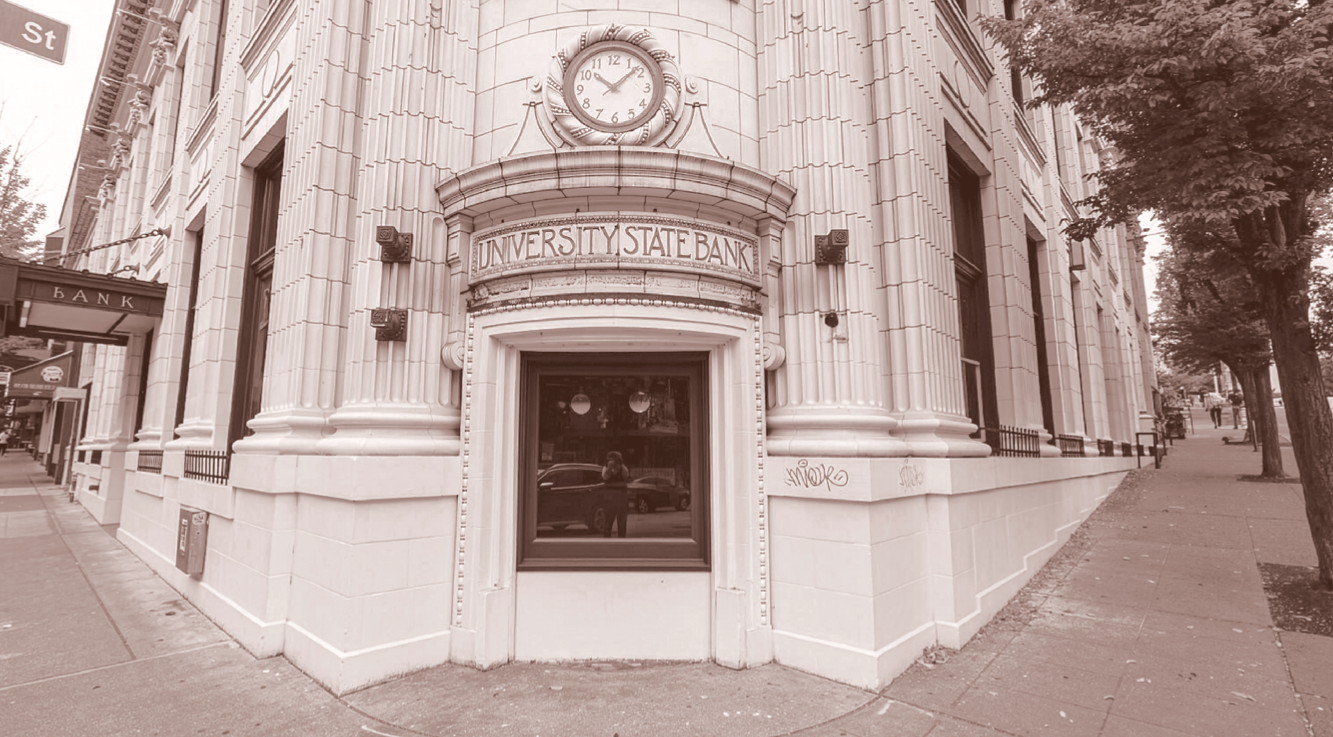
Located in the University District of Seattle, at the corner of NE Forty-Fifth Street and University Way, the University Bank Building appears solid and unmistakably a former bank. The two-story white terracotta-clad building with its neoclassical facade and intricate detailing, once a quiet place of business transactions, now feels alive with movement and laughter. Through the heavy bronze doors, the space within has been refitted with large, blue, bulbous climbing walls and clouds of chalk dust fill the air while amateur and expert climbers scale the heights of the voluminous space.
Here, in a dramatic transformation of typology, the Bouldering Project has meshed old and new to form a distinctive user experience that blends historic design with modern innovation. By curating a place for indoor rock climbing inside a space once intended for quiet, quick business transactions, they have made the building into a place people joyfully frequent multiple times a week and a vessel for a vibrant, welcoming community.
The gym’s location near the University of Washington campus allows it to attract student climbers while aiming to foster an inclusive place for all, as indicated through my conversation with Kara Stone, General Manager of the U District Bouldering Project and Mo Herbert, Regional Marketing Manager for the organization. Using adaptive reuse can positively transform user experience through thoughtful designed juxtaposition of old and new, which can be more beneficial than conventional purpose-built gyms both economically, visually, and when considering the eco-sustainability of such projects. The climbing gym is not just a gym but a place to truly immerse yourself into what it means to reclaim a building so rich in history and the positive interactions that come from that.
This historic landmark, built in 1912, is a mainstay of the U District and its history is well documented through its accreditation as a historic landmark which occurred in July of 2021 by Seattle’s Landmarks Preservation Board. In the early twentieth century, when the university was establishing itself, the neighborhood lacked one thing: a bank. The surrounding commercial development was just beginning and there was an increased need for access to staples of everyday life. Money was tight following the 1893 financial crisis, but the founders of the neighborhood and University raised $25,000 to establish a bank. Following all the planning and fundraising, the University Bank Building was finally constructed as a two-story concrete and steel building at the corner of NE Forty-Fifth Street and University Way. The historic landmark has been around throughout the growth of the U District, making this place a special place for longtime residents.1
The University Bank Building underwent its first renovation in 1926, expanding its interior to better serve the growing U District community. Today, the building has gone through another transformation, albeit for an entirely different purpose. The Bouldering Project, known for adaptive reuse projects in Seattle including their Fremont location and the Upper Walls, is breathing new life into the historic places they inhabit.
After entering the building through the glazed bronze doors, you can still see the original bronze sheet metal canopy suspended overhead. The open interior is filled with colorful blue climbing surfaces on white drywall. Original marble columns and floors guide you to the mats where the real fun begins. As you traverse through the space, ascending and descending through a network of staircases, you are met with new discoveries at every turn. Having multiple ways to navigate the building makes it feel like a maze or an adventure, as if the building itself is a climbing gym.
The main floor features the reception area, two large climbing walls, and a fitness gym. On the second level, the space opens into the mezzanine and leads into the former historic ballroom, now transformed into the main climbing area. Here, you are surrounded by large windows that overlook the neighborhood, vibrant climbing walls, soft mats, and a powerful sense of community and connection.
An unexpected but impressive reuse of the building is in the basement: the old bank vault, having lost its original purpose, is now a sauna. This space is something of a treasure in the way it combines old and new. According to Kara Stone, the General Manager of this location, the Bouldering Project wanted to maintain the original bank aesthetics by keeping the safety deposit boxes visible behind the walls of the sauna. There are numerous old artifacts to find if you keep an eye out and wander around this building.
Frequent users of this location, such as Gail Sohm, a PhD student at the University of Washington and avid climber, and Brendan Colford, a Master of Architecture student at the same university, mention the gym’s unique atmosphere and thoughtful spatial design as things they appreciate about the new location. Sohm is drawn to this Bouldering Project location because it is in her neighborhood, while Colford appreciates its proximity to the light rail.
Both climbers describe being overcome at first by the abundance of natural light that pours through the large windows and the spaciousness of the interior. “I’m impressed by how the gym utilizes the entire space, including hidden stairwells, and the mezzanine area with work and lounge areas,” says Sohm. Colford agrees: “The windows are brilliant here on the second floor. You can get a great bird’s eye view of what is going on outside. The basement is also one of my favorite aspects of the building.”
The Bouldering Project has renewed the building. Being able to keep some elements of the old while breathing new life and use into it has been awe-inspiring to visitors. When Sohm moved to the University District two years ago, she remembered noticing the vacant building and hoping something was going to occupy the space before she graduates so she could truly see what the historic place was all about.
Creating a third place, a social environment which is separate from home and work, is especially vital in today’s world. “The Bouldering Project fosters inclusive spaces as well as places to grow community, where everyone is welcome and able to come in and try climbing without any prior experience,” says Mo Herbert, Regional Marketing Manager for the Bouldering Project on the West Coast, which includes locations in Seattle, Salt Lake City, and Tempe. General Manager Kara Stone adds, “Building community is so much in [Bouldering Project’s] DNA.” Such as how much BP leans into the student environment while also creating a holistic community for all.
The Bouldering Project serves as a compelling example for how urban spaces can be reimagined to support community engagement through adaptive reuse. It demonstrates how thoughtful design can transform unconventional spaces into vibrant hubs of connection and activity. During my conversation with Stone, she said that one of the coolest things about the U District is how tight-knit the business district is. “Everyone was so happy to have us join—not just for the building, but having a climbing gym on the corner that is open early and closes late really added another dimension of safety and community to the very busy street.”
Adaptive reuse enhances user experience by allowing people to thrive in spaces that carry both historical depth and the promise of future memories. Connecting history and place can allow the users to feel more connected to these invisible layers of history. Reusing buildings helps preserve local character and architectural heritage while breathing new life into spaces, grounding users in the context of the community. Blending the past and present in functional, engaging ways can truly enrich community life as it creates open and inclusive spaces for all.
FOOTNOTES
1. Zabalza-Winn, Rachel. “University National Bank: 2022 Community Investment Award.” Historic Seattle, September 16, 2022.
2. “Historic Preservation - Neighborhoods | Seattle.Gov.” Seattle.gov. Accessed November 2, 2025. https://www.seattle.gov/neighborhoods/historic-preservation.