The typical take-make-dispose construction lifecycle is widely recognized by built environment practitioners as unsustainable. More and more designers are asking the question: how do we make this old model obsolete?
Eventually, our way of building will deplete our natural resources, and scarcity will compel us to reuse materials. Many designers aren’t waiting for material reuse to become mandatory—they already treat existing buildings as valuable material sources for future projects.
Adaptive reuse—repurposing entire buildings—dates back centuries, seen in both Ancient Rome and parts of Asia. But since the late 20th century, a new movement of designers have embraced this old approach.
Designers have also responded to the threat of material scarcity by developing ways to reuse building materials. Reusing steel is costly and labor-intensive, and concrete is even harder to repurpose. By comparison, mass timber reuse is much more feasible—laminated wood beams, columns and slabs can be disassembled and reassembled with minimal modification.
Although today’s mass timber buildings won’t reach the end of their lifecycles for a hundred years or more, the industry can proactively act to imagine and develop prototypical frameworks so that designers and builders are ready to adopt these approaches once the materials become available.
In Winter 2025, students in the University of Washington CLT Cannibalism studio—led by Susan Jones and atelierjones—explored the future of mass timber, envisioning how salvaged materials from today’s structures could find new life in the next generation of buildings.
Throughout the quarter, I conceived and developed Salvage Studio—a hypothetical design and production facility that transforms waste streams into raw material for furniture manufacturing. The facility integrates every stage of the process—materials recycling, production, design, fabrication and sales.
Salvage Studio showcases repurposed materials at multiple scales. At the object scale, resident designers repurpose timber offcuts and small granular waste—such as plastic e-waste and coffee shells—to craft furniture. At the architectural scale, the building adapts mass timber structural elements and repurposes a disused warehouse complex to accommodate a new program.
The mass timber components of Salvage Studio—glulam columns and beams and cross-laminated timber (CLT) slabs come from Heartwood, a 67,000-square-foot apartment building in Seattle’s Capitol Hill neighborhood.
The repurposed building, the Bardahl Manufacturing warehouse complex, sits in Seattle’s Ballard neighborhood. Spanning 36,000 square feet, it’s a patchwork of mass timber warehouses built throughout the '50s and '60s. The complex stands out for its exuberant cladding: bumblebee-yellow paint and a striking green glass-clad office building that juts out from the south side, a celebration of mid-century modern vitality. A 50-foot-tall metal sign crowns a bowstring truss warehouse, prompting passersby to “Add Bardahl Oil.”
Bardahl is a motor oil producer and distributor with a healthy business. However, as fossil fuel use declines, businesses like Bardahl will shrink, leaving their buildings vacant.
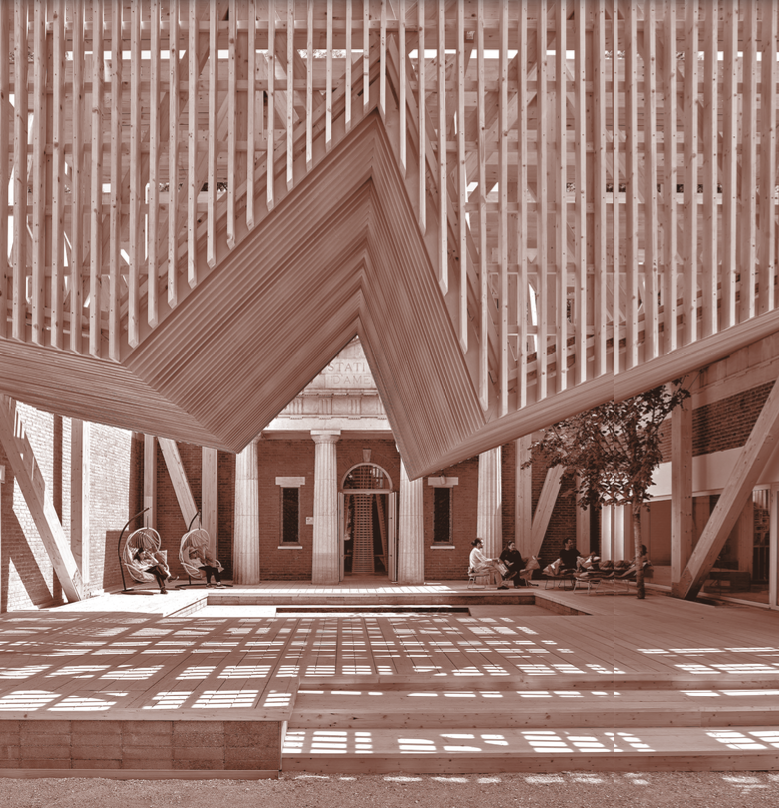
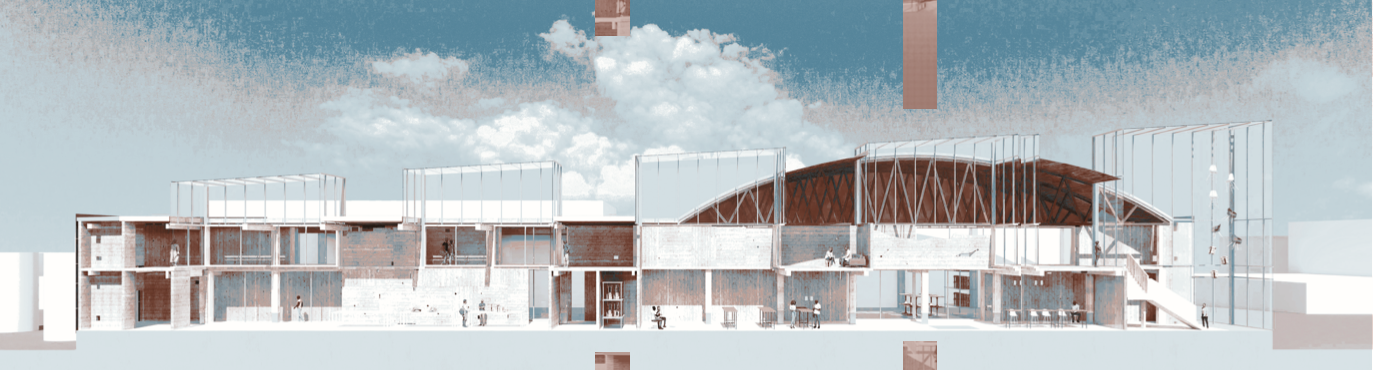
The defining architectural move is a mass timber insertion into the warehouse buildings. An 8,000-square-foot structural bar bisects the space. A series of lightwells punctuates the insertion, emerging from the roofline. Green steel panels cap the ends, providing protection and a distinct visual contrast. From the adjacent road, the first thing visible isn’t mass timber—it’s a 30-foot-tall lightwell, standing like a lantern marking the main eastern entrance. Inside the lightwell, furniture dangles from the ceiling, and embedded shards of e-waste catch the sun and sparkle like chandelier lights. Looking further into the building, the mass timber begins to become visible.
In the lobby, a staircase of mass plywood leads visitors upstairs to the showroom. At the top, the space opens up—weathered timber bowstring trusses stretch across the warehouse. CLT slabs form the floor, and some are tilted upright as walls. Because the existing warehouse protects the water-sensitive wood, the CLT panels can lay bare the history embedded in scars from their previous use, such as intentional penetrations for mechanical equipment and chunks that have been removed because of cracking and water damage.
While the exterior appears opaque, the interior is unexpectedly open. The lightwells pierce through to the ground floor, giving showroom visitors a glimpse into the design studio below. On the west side of the building, the fabrication lab occupies a wide-open double-height space visible from a corridor situated on its north side.
This is a building within a building, complete with an internal façade, visible from the warehouse spaces. The tilted-up CLT panel walls alternate rhythmically with large plywood-framed glass panels that visually link the employees in the warehouse with the designers in the studio and the visitors in the showroom. Visitors observe the entire design and fabrication process, gaining insight into material reuse and the circular design cycle.
The insertion follows its own structural grid, necessitating the removal of several existing concrete columns that once supported the bowstring trusses. A robust set of relatively young glulam beams provide new supports for the aged bow-string trusses.
Like all structures, this one holds value as a future material source, and it’s designed with this in mind. Current mass timber construction relies on hefty steel fasteners that are difficult to remove with conventional tools. Salvage Studio takes an alternative approach, using all-wood joinery inspired by traditional Japanese craft, allowing for easy disassembly with minimal material disruption. Throughout the building, these joints are expressed in the spliced connections of reclaimed timber beams.
Speculative projects like Salvage Studio present future-focused solutions, but adaptive reuse and mass timber reuse still face barriers to widespread adoption. Beyond designing for disassembly, the industry must establish frameworks for assessing, cataloguing and storing materials between reclamation and reuse. Without these systems in place, salvage remains an ideal rather than a practical reality.
In many cases, adoption boils down to the bottomline. Until reuse becomes more efficient and less costly, the building industry will continue to extract, use, and dispose of building materials—an unsustainable cycle that feeds environmental degradation. Rather than waiting for cost reductions, built environment practitioners can take proactive steps to champion reuse as a priority, integrating circular principles into budgets and project timelines.
High costs and logistical challenges stem from gaps in industry expertise. Many architects lack experience in mass timber construction and adaptive reuse. Builders tend to be risk-averse, but contractors embracing mass timber expertise as a competitive advantage signals promise for the industry’s future. The reluctance to innovate is not just a practical concern—it’s a cultural one. Shifting perspectives on reuse from an occasional practice to an industry norm can pave the way for more sustainable building approaches.
Regulatory barriers—such as building codes and land use restrictions—also make adaptive reuse costly. Variability in local codes and design parameters further complicate mass timber projects. While regulatory complexity can’t be ignored, it also offers opportunities for progress. By collaborating with architects and builders, policymakers can help create clearer pathways for reuse, streamlining approvals and incentivizing sustainable practices.
Despite these challenges, adaptive reuse and mass timber complement each other naturally—together, they create buildings that are greater than the sum of their parts. Salvage Studio takes this idea further, embedding reclaimed mass timber structures within disused buildings to breathe new life into old materials while adapting to the evolving needs of communities. The industry has an opportunity to embrace such approaches, rethinking materials not as disposable commodities but as long-term assets.
Beyond its practical benefits—extending the life of materials and reducing waste—reuse carries a poetic dimension. It blurs the line between past and present, weaving memory, history, and energy into the fabric of new spaces. But reuse is more than an aesthetic or conceptual choice—it’s a fundamental step toward a more resilient built environment. No longer just an experimental approach, it has the potential to shape a future where buildings actively contribute to environmental renewal rather than depletion.
Speculative projects like Salvage Studio are just the tip of the iceberg. Other organizations are exploring ways to make circular construction a reality. If you’re interested in more on this:
• The Circular Future Hackathon, hosted by Metropolis Magazine in July and August of 2024, invited practitioners from across the Architecture, Construction, and Engineering disciplines to explore novel ways to eliminate obstacles to circularity. Proposals included a framework for assessing usability of reclaimed materials.
• The Circular Construction Lab at Cornell University is analyzing the current linear construction model and how to move forward with circular construction methods, including building and material reuse.
GLOSSARY
Mass Timber. A broad category of prefabricated wood products used for structural applications in buildings. It includes cross-laminated timber (CLT),glue-laminated timber (glulam) mass plywood panels (MPP) and a range of other products. They are strong, stable, and sustainable, making them a viable replacement for concrete and steel in a wide range of building scales and typologies. Mass timber has been used in construction for over 200 years, but in recent decades, it has experienced a renaissance because of its sustainability, efficiency, and aesthetic appeal.
Cross-Laminated Timber (CLT). A prefabricated wood product made by gluing together layers of lumber in perpendicular orientations, enhancing strength, stability and fire resistance. They range from 2 to 10 feet wide, with lengths up to 60 feet and thicknesses reaching 20 inches. Structurally, they’re typically used in walls, floors, and roofs, replacing concrete and steel. Because they are cut to size at the mill, installation is fast and efficient. CLT was introduced in Europe in the early 1990s but didn’t make its way to the US until the early 2000s.
Glue-Laminated Timber (Glulam). A prefabricated wood product made by gluing together multiple layers of dimensioned lumber with moisture-resistant adhesives. Its strength and stability make it suitable for use as beams and columns as a replacement for concrete and steel. Glulam beams trace their origins to England in the 1860s and were introduced to the US in the 1930s.
Mass Plywood Panels (MPP). Large, strong sheets of engineered wood made by layering thin wood veneers and gluing them together with adhesives. They are lighter and more efficient than CLT while still being structurally strong.