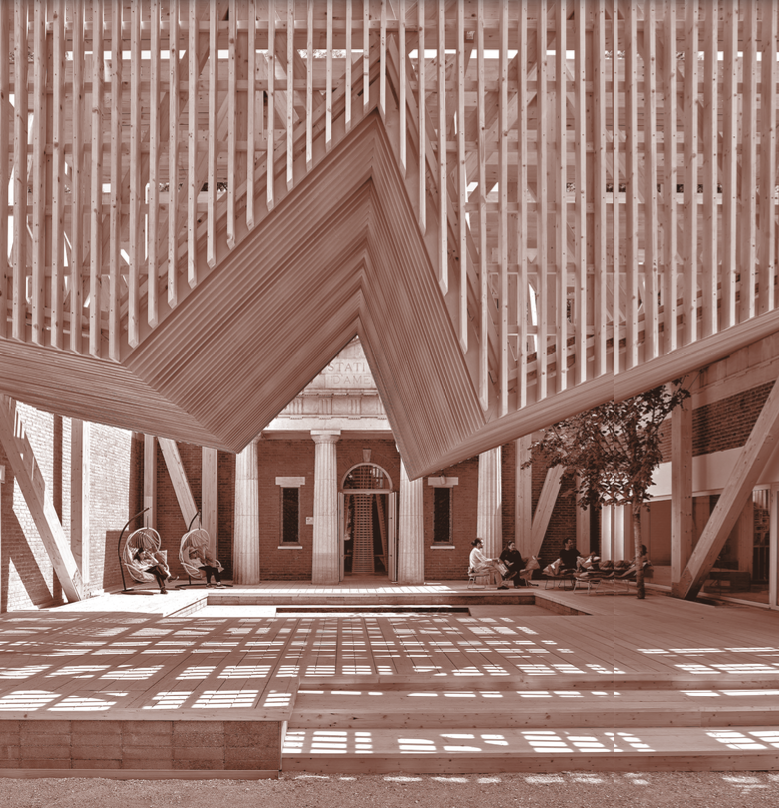
Architecture has long prized the new: new ideas, new forms, new ground to break. But in an era of climate urgency, the most radical act might be to work with what we already have. Around the world, the construction industry is responsible for over a third of global carbon emissions, much of it locked into materials we discard far too early. What if buildings were not designed to last forever, but to come apart gracefully? What if the future of architecture is not about permanence at all, but about reuse, transformation, and reassembly?
This is the thinking behind circular lifecycle design, a growing movement that challenges architecture’s linear trajectory. Typically, this follows the path of extract, build, use, demolish. Circular design asks us to blur those stages and to design not just for occupation, but for deconstruction and reuse. While still far from mainstream, the movement is gaining momentum as architects begin to reimagine the full lifespan of a building as part of its design ethic.
While circular design is often framed as an environmental necessity, it also holds unique cultural potential in a city like Seattle. Here, where development pressure and affordability are urgent concerns, designing for reuse could help reduce long-term costs and create more adaptable spaces for the public good. The idea that a building can evolve over time, serving different uses or communities, speaks to a broader civic value. Circular design is not just good for the planet. It is also good for people, and increasingly, good for business.
As a fourth-year architecture student, I have spent the past year trying to understand what it might mean to practice this kind of thinking and how it is showing up in Seattle. I spoke with Jenn Chen, an interior designer formerly at LMN Architects whose professional focus includes sustainable design and lifecycle thinking. Chen has contributed to the firm’s design research in areas such as material reuse and low-carbon interiors. Her insights offered a grounded perspective on how circular strategies like design for disassembly (DfD), material tracking, and early-stage carbon tools are gradually being integrated into civic and institutional projects.
The Problem with Linear Architecture and a New Path Forward
Most buildings are designed to last, until they are not. We rarely think beyond the moment of ribbon-cutting. But the materials embedded in our structures, including steel, concrete, adhesives, and plastics, often have lifespans that far exceed the building itself. Once the building is disassembled, these materials are difficult to salvage or recycle. According to the EPA, in 2018 more than 600 million tons of construction and demolition waste are generated annually in the U.S. alone. Much of this material is still usable in theory, but destined for landfill in practice.
Circular lifecycle design attempts to break this pattern. It encourages architects to ask: How will this building come apart? What happens to its pieces? Can they serve another life? And can we make reuse not just possible, but preferable?
In Seattle, LMN Architects is one firm asking these questions in both its research and practice, incorporating circular design into more and more of its projects. “Circular design is emerging,” Jenn Chen says. “Its presence depends on the industry’s capabilities, but also on the architect’s initiative. These conversations don’t happen on every project, but when they do, it’s usually early on.”
As interest in circularity grows, firms are also exploring how to position its benefits more strategically. Framing reuse not as sacrifice, but as smart planning, helps clients see circular design as an investment in long-term flexibility, cost savings, and future value.
In some LMN projects, teams conduct salvage walk-throughs at the outset to identify materials such as doors, carpets, and casework that can be retained or reused. “It’s small,” Chen says, “but it’s something.” LMN is also exploring design for disassembly by focusing on how materials are connected. That includes avoiding adhesives, choosing screw-based systems over nails, and selecting finishes that are easier to remove from walls. It’s less about inventing new materials and more about making smarter use of existing ones.
One of the most promising materials in this context is mass timber, a strong, lightweight engineered wood product composed of laminated layers. “It’s light, strong, and modular,” Chen explains. “And unlike concrete, it doesn’t have rebar, so you can actually take it apart.” Mass timber’s precision and prefabrication make it ideal for buildings designed to be disassembled or repurposed, though that intention is not always realized in practice.
That’s why projects like Heartwood are so notable. Developed by Community Roots Housing and designed by local firm atelierjones, Heartwood is one of the country’s tallest all-mass-timber workforce housing projects. Although not a reuse project, its modular design and reversible connections exemplify forward-thinking lifecycle planning. Heartwood’s bolted, rather than bonded, elements are intended to be dismantled and reused. It serves as a prototype for what could be possible if we designed every building as part of a larger circular system, not just a one-time event.
Overcoming Barriers to Circular Thinking
Still, circular design faces resistance. “There are deep cultural barriers,” Chen says. “There’s this belief that new is always better.” Reused components often require storage space, which most projects do not budget for. There’s also a disconnect between supply and demand. No comprehensive network exists to connect those who have salvageable materials with those who want them. However, platforms like Harvest Map and Rheaply are beginning to fill that gap, connecting reuse suppliers with designers and contractors.
Technical limitations persist as well. Designers often don’t know what is in the materials they are reusing. If a component has an unknown chemical history, reusing it can be legally or ethically risky. Meanwhile, carbon tracking remains inconsistent across platforms, leaving architects without clear incentives to prioritize reuse over recycling or new production. “A lot of it comes down to mindset,” Chen says. “People drop reuse ideas the moment they seem slightly more expensive or difficult.” But change is coming, and not just from within the culture of design. It is also happening through the tools designers use. LMN is experimenting with C.scale, an open-source carbon calculator that lets architects estimate embodied emissions early in the design process. Unlike many carbon tools that require detailed specifications, C.scale works at a conceptual level. It helps designers ask big-picture questions from the start: Should we use mass timber? Can we reduce glazing? What if we retain the existing structure?
As a student, I find C.scale exciting because it gives designers more agency. It makes the environmental consequences of design visible, not just in the abstract, but through specific, early-stage decisions.
LMN is also collaborating with organizations like Urban Heartwood, which salvages wood from deconstructed buildings and felled urban trees for reuse in interiors. These small partnerships hint at a larger shift. Designers are beginning to steward old materials into new lives, not just imagining new buildings.
Rethinking Notions of Permanence
Circular design asks architects to reconsider the very notion of permanence. This is especially challenging in civic projects, where longevity is often equated with value. “It’s easier to do DfD in something like a warehouse,” Chen admits. “In civic work, it’s harder. The systems are more complex, and the public expects lasting impact.”
But permanence and transformation do not have to be opposites. What if civic architecture were designed to evolve, to be maintained, adapted, or even disassembled over time? Not as a failure of design, but as its fulfillment. In a moment when the climate crisis demands a rethinking of how we use natural resources, circular design offers a bold, pragmatic path forward. The new is not totally separate from the old, and the legacy of a building can be measured not just by how long it stands, but by how well its parts continue to serve.
We are at a moment where the boundaries that have shaped architectural thinking, between building and unbuilding, permanence and decay, use and reuse, are beginning to soften. As someone just entering this field, I find that both daunting and hopeful. Circular design is still rare, still messy, and still slowed by systemic obstacles. But it is a necessary reimagining of what architecture is for.
In school, we are taught to design buildings that make a statement. But perhaps the most powerful statement is not how buildings rise, but how they continue to contribute, even after their first life is over. Buildings are not static objects. They are systems in motion. When designed for disassembly, a building’s end becomes part of its meaning , not its failure, but its future.